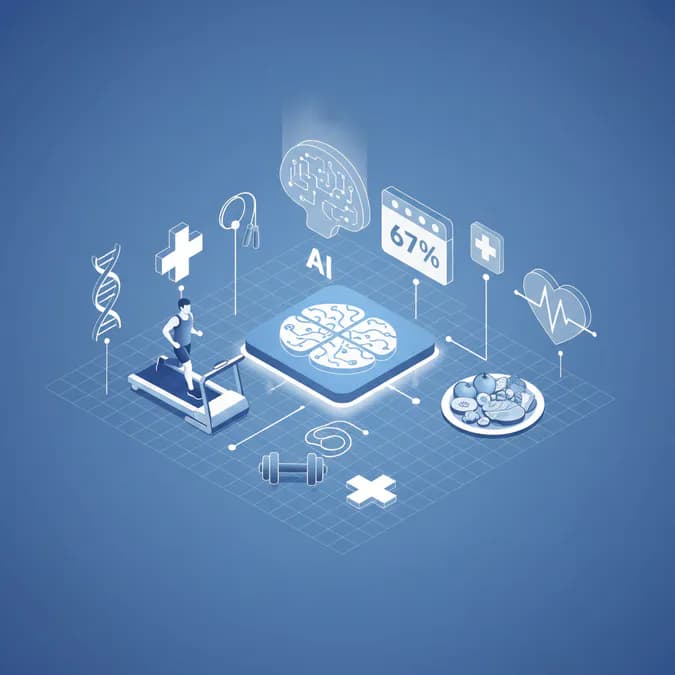
Google's Med-PaLM AI system has achieved a significant milestone by scoring 67% on the US Medical Licensing Examination (USMLE), demonstrating substantial progress in artificial intelligence's ability to handle medical knowledge and reasoning. This achievement represents a crucial step forward in AI development, though it also highlights the considerable gap that still exists between AI capabilities and practicing clinicians. The Med-PaLM medical exam score illustrates the ongoing evolution of AI in healthcare.
Med-PaLM's Medical Exam Achievement
The 67% score on the USMLE places Med-PaLM above many previous AI models but below the typical passing threshold for human medical professionals, who generally score in the 85-95% range. This performance gap is intentional and reflects Google's cautious approach toward AI in healthcare—prioritizing safety and accuracy over speed to market.
What makes Med-PaLM's performance particularly significant is not just the score itself, but how the AI arrived at its answers. The system demonstrates improved reasoning capabilities and the ability to provide safer medical responses compared to earlier AI models. This focus on safety is crucial in healthcare, where incorrect information could have serious consequences for patient outcomes.
Why Safety Matters More Than Speed
The development of Med-PaLM represents a broader trend in the technology industry toward creating AI systems specifically designed for medical applications. Unlike general-purpose AI models, Med-PaLM was trained on medical literature, clinical guidelines, and educational materials to develop domain-specific expertise.
Google's approach emphasizes that achieving a higher score isn't the primary objective. Instead, the focus remains on ensuring that the AI provides accurate, evidence-based information that healthcare professionals can trust. This philosophy reflects the reality that medicine isn't just about knowing facts—it's about applying knowledge safely and appropriately to individual patient situations.
Understanding the AI-Clinician Gap
The 67% score also reveals important limitations in current AI capabilities. Medical practice requires not just knowledge recall but clinical judgment, patient interaction skills, and the ability to make decisions in complex, real-world situations. These nuanced aspects of medicine remain challenging for current AI systems, even advanced ones like Med-PaLM.
Key areas where AI still lags behind clinicians include:
- Integrating patient history and context into diagnostic reasoning
- Navigating ethical dilemmas and treatment trade-offs
- Communicating complex medical information to patients
- Making decisions under uncertainty with incomplete information
- Adapting to individual patient preferences and values
What This Means for Healthcare's Future
Experts in the field view this development as a stepping stone rather than a destination. The goal isn't to replace physicians but to create tools that can assist healthcare professionals by providing evidence-based information, helping with diagnosis support, and reducing administrative burden. This collaborative approach between AI and human clinicians could potentially improve healthcare delivery while maintaining the essential human elements of medical practice.
The implications for healthcare are substantial. As AI systems become more capable, they could help address physician shortages in certain specialties, provide diagnostic support in underserved areas, and accelerate medical research. However, regulatory frameworks and clinical validation processes will need to evolve to safely integrate these tools into medical practice.
The Path Forward for AI in Medicine
Med-PaLM's performance also highlights the importance of transparency in AI development. Google's willingness to publish the actual score and acknowledge where the system falls short demonstrates responsible AI practices. This openness allows the medical community and regulators to understand both the capabilities and limitations of the technology.
Looking forward, the trajectory of AI in medicine suggests continued improvement. Each iteration of these systems becomes more sophisticated, but the medical field's cautious approach—requiring extensive testing and validation before clinical deployment—ensures that safety remains paramount. The 67% score on the USMLE is impressive, but it's the commitment to making AI safer and more reliable that truly matters for healthcare's future.
As AI continues to evolve, the focus must remain on how these technologies can enhance human expertise rather than replace it, ensuring that patients receive the best combination of technological capability and human judgment.
Key Takeaways
1. Med-PaLM scored 67% on the USMLE, indicating progress but highlighting the gap with human clinicians.
2. Safety and accuracy are prioritized over speed in AI development for healthcare.
3. AI can assist healthcare professionals but cannot replace the nuanced decision-making required in medical practice.
4. Future AI advancements must focus on transparency and collaboration with human expertise.
Frequently Asked Questions
What is the Med-PaLM medical exam?
Med-PaLM is an AI system developed by Google that scored 67% on the USMLE, showcasing its capabilities in medical knowledge and reasoning.
Why is the 67% score significant?
This score indicates that while Med-PaLM shows promise, it still falls short of the typical passing threshold for human medical professionals.
How does Med-PaLM improve patient care?
Med-PaLM aims to assist healthcare professionals by providing evidence-based information and diagnostic support, enhancing overall patient care.
What are the limitations of AI in medicine?
AI currently struggles with integrating patient context, ethical decision-making, and effective communication, which are critical in medical practice.