
Do You Need a Prescription for a CGM in 2026?
Learn whether you need a prescription for a CGM in 2026, including FDA regulations, over-the-counter options, and how to get one from your doctor.


On this page
Introduction
Continuous glucose monitoring has transformed how people with diabetes track their blood sugar in real time. Instead of finger-stick tests several times a day, a CGM provides continuous insights into glucose patterns, trends, and variability. But one question consistently arises for anyone considering a CGM: do you need a prescription for a CGM in 2026?
The answer depends on the device, your diagnosis, and how you plan to use it. While the FDA and regulatory agencies have acknowledged CGM's clinical utility in managing established type 1 diabetes and optimizing glycemic control, most systems on the market today require a healthcare provider's prescription. At the same time, the landscape is shifting — newer over-the-counter wellness devices and evolving regulatory guidance are beginning to open pathways for non-prescription access in specific contexts.
This article walks through the current prescription requirements for CGMs, what the regulatory environment looks like in 2026, and what alternatives exist if you're exploring glucose monitoring without a traditional prescription. We'll also look at Victoza Generic and Cost in 2026: What to Expect and related medication contexts that often accompany CGM use. Whether you're newly diagnosed, managing long-standing diabetes, or supporting a family member, understanding the prescription landscape helps you make informed decisions about monitoring tools.
In the sections ahead, we'll clarify what CGMs are and how they work, outline the current prescription requirements across major devices, explore future trends in accessibility, and review alternatives for those seeking glucose insights outside the traditional prescription pathway.
Understanding CGMs
A continuous glucose monitor (CGM) is a wearable device that tracks glucose levels around the clock, providing a real-time picture of how blood sugar moves throughout the day and night. Unlike fingerstick meters that capture a single moment, a CGM reads glucose concentrations in the fluid between cells — called interstitial fluid — every few minutes, building a continuous trace that shows trends, peaks, and dips.
CGM devices use electrochemical technology, specifically an enzyme called glucose oxidase, which reacts with glucose molecules in the interstitial fluid to generate a small electrical signal. That signal is translated into a glucose reading and transmitted to a receiver or smartphone app, where you can see your current number, a directional arrow showing whether glucose is rising or falling, and a graph of recent history.
Why CGMs Matter in Diabetes Management
For people managing diabetes, CGM fills in the gaps that fingerstick testing leaves open. A single fingerstick tells you where you are at that instant, but it doesn't show you where you're headed or what happened overnight. CGM captures the full fluctuation range of daytime and nighttime blood glucose, making it easier to spot patterns — post-meal spikes, overnight lows, or the impact of exercise — that intermittent testing might miss.
This continuous visibility supports tighter glucose control and reduces the risk of both high and low blood sugar events. The FDA and European Medicines Agency have acknowledged CGM's clinical utility in optimizing glycemic control and reducing hypoglycemia risk, and multiple devices have been approved for use in established type 1 diabetes.
How CGM Readings Differ from Fingerstick Meters
Because CGM measures glucose in interstitial fluid rather than blood, there's a physiological lag — typically 5 to 15 minutes — between a blood glucose reading and the CGM trace. When glucose is changing rapidly, the two numbers may not match exactly. That lag is normal and doesn't mean the CGM is inaccurate; it reflects the time it takes for glucose to move from the bloodstream into the surrounding tissue.
It's also worth noting that even among current-generation CGM systems, there can be variability. A recent comparative study found that mean glucose readings can differ by up to 1.1 mmol/L (roughly 20 mg/dL) and time in range can vary by nearly 20% between devices, even when worn simultaneously by the same person. This device-dependent variability underscores the importance of understanding your specific CGM's performance and confirming any unexpected readings with your care team.
CGM in Context: Who Uses It and Why
CGM is most commonly prescribed for people with type 1 diabetes and those with type 2 diabetes who use insulin, but its use is expanding. People with prediabetes, gestational diabetes, or type 2 diabetes not on insulin may also benefit from CGM data to understand how meals, activity, and medications affect their glucose. The technology has become an integral tool for assessing glucose management, with metrics like time in range, time above range, and time below range now standard in clinical practice.
For newly diagnosed individuals or caregivers coordinating care, CGM can reduce the guesswork and anxiety that come with managing an invisible condition. Seeing glucose in real time — and understanding what drives the numbers up or down — builds confidence and supports more informed conversations with your care team. If you're navigating a new diagnosis and want to understand what your A1C number means in everyday terms, our guide on A1C conversion explains how A1C translates to average blood sugar and what steps you can take to bring it down.
Current Prescription Requirements
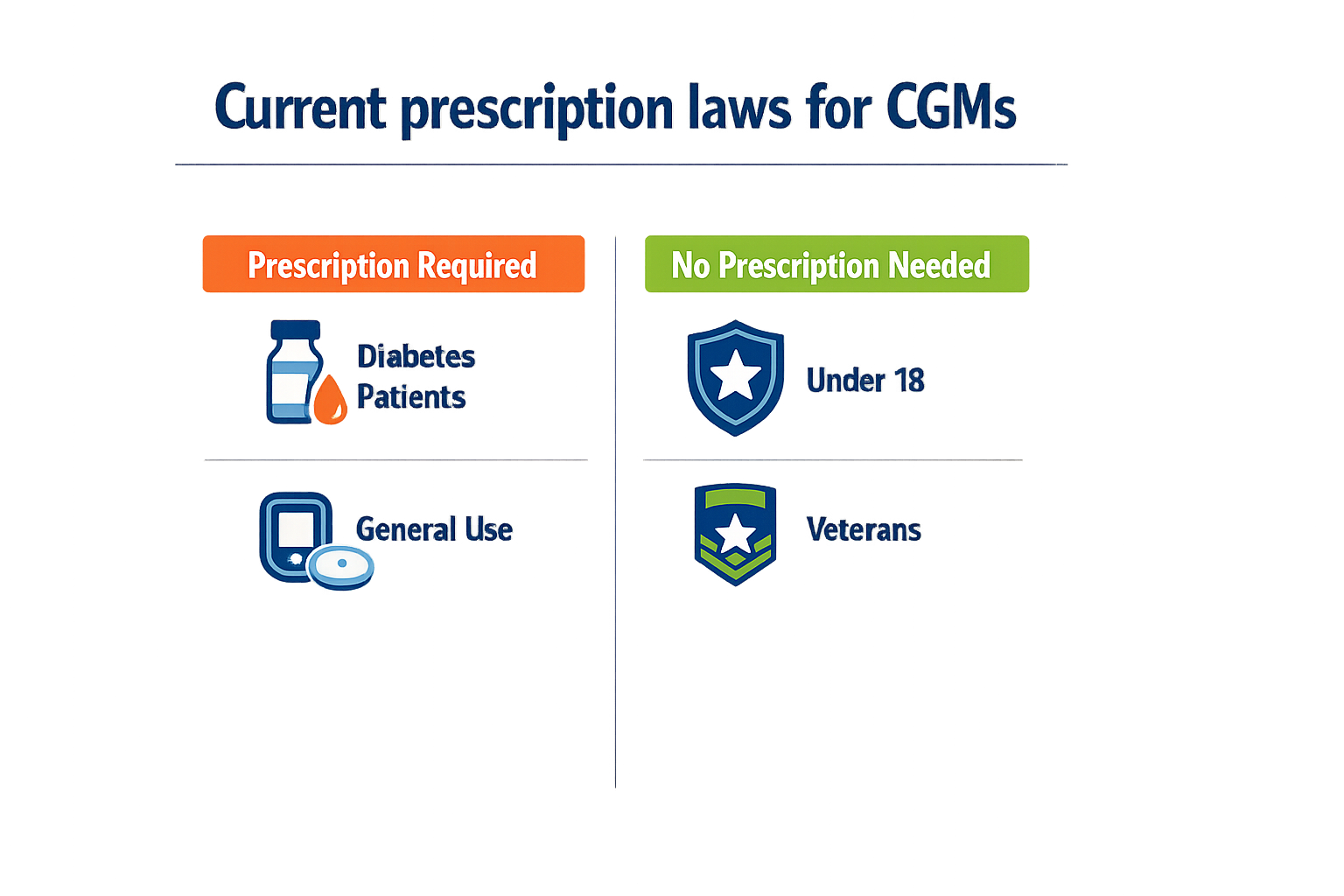
In 2026, most continuous glucose monitors still require a prescription from a licensed healthcare provider. The FDA has approved several CGM systems — including the Abbott Freestyle Libre, Dexcom G6, and Medtronic Guardian — and each carries prescription-only status under federal device regulations. These devices are classified as Class II or Class III medical devices, meaning they must be ordered by a physician, nurse practitioner, or physician assistant who can assess whether CGM use is appropriate for your diabetes management plan.
Who Needs a Prescription for a CGM
Anyone seeking a prescription CGM must obtain an order from their care team. This typically involves a clinic visit or telehealth appointment where your provider reviews your diabetes type, current treatment regimen, A1C history, and glucose-monitoring habits. Prescription CGMs are most commonly prescribed for people with type 1 diabetes or insulin-treated type 2 diabetes, where real-time glucose data helps prevent hypoglycemia and guides insulin dosing. However, providers may also prescribe CGMs for people with type 2 diabetes not on insulin, gestational diabetes, or prediabetes when closer glucose tracking supports treatment decisions.
The prescription requirement exists because CGM data can influence medication adjustments, insulin titration, and other clinical decisions that require professional oversight. If you're wondering whether you qualify, the best step is to ask your endocrinologist or primary care provider whether a CGM fits your current management strategy. You can also review A1C Conversion: What Your Number Means and How to Lower It to understand how your recent lab work might support a CGM request.
Exceptions and Over-the-Counter Options
As of early 2026, the FDA has not yet approved a fully over-the-counter CGM for general consumer use. Some wellness-focused glucose monitors marketed to people without diabetes do not carry FDA approval as medical devices and are sold without a prescription, but these systems are not the same as the prescription CGMs used in diabetes care. They typically lack the accuracy standards, clinical validation, and real-time alerts that FDA-approved devices provide.
If you do not have a prescription and need glucose data, your options are limited to traditional fingerstick meters (available over the counter) or waiting for regulatory changes that may expand access to non-prescription CGMs in the future. Any device claiming to offer CGM-level insights without FDA clearance should be approached with caution — accuracy, data security, and clinical utility vary widely outside the prescription pathway.
Future Trends in CGM Accessibility
CGM technology is evolving rapidly, and the regulatory landscape is shifting to keep pace. While the FDA and European Medicines Agency have acknowledged CGM's clinical utility in established type 1 diabetes, their 2023 draft guidance still positions CGM as a valuable tool rather than a primary endpoint in prevention or preservation trials. This signals a cautious, evidence-building phase — regulators want more data before expanding CGM's official role beyond active diabetes management.
Regulatory Evolution and Clinical Recognition
The FDA's recent guidance recognizes CGM for optimizing glycemic control and reducing hypoglycemia risk in people already diagnosed with type 1 diabetes. However, the agency has not yet elevated CGM metrics to standalone endpoints for trials aimed at preventing or slowing disease progression. This conservative stance reflects the current state of evidence: CGM excels at tracking glucose dynamics in real time, but it does not directly measure beta cell health or underlying pathophysiology — areas where metabolic tests and modeling still hold more weight.
That said, the trajectory is clear. Prospective studies are underway to establish CGM-derived metrics — time in range, time above range, glucose variability — as prognostic biomarkers for disease progression. The focus is on patient selection, stratification, and enrichment in intervention trials, contexts where biomarker qualification has historically succeeded. If these studies deliver robust, reproducible data, we may see expanded regulatory endorsement by 2026 or shortly thereafter.
Device Variability and Standardization Challenges
One hurdle to broader CGM adoption is device-to-device variability. Even current-generation systems can diverge substantially: a recent comparative study found that mean glucose readings can differ by up to 1.1 mmol/L between devices, and time in range can vary by nearly 20%. This inconsistency complicates efforts to standardize CGM metrics for regulatory or clinical decision-making.
Short-term research priorities include harmonizing CGM protocols, validating metrics across device platforms, and ensuring that findings from one sensor model translate reliably to another. Until these technical and methodological issues are resolved, regulators are unlikely to expand CGM's formal role in prevention or early-stage diabetes trials.
Patient and Caregiver Perspectives
Accessibility is not just a regulatory question — it is also a practical and emotional one. A study evaluating CGM acceptability in parents of children at risk for type 1 diabetes found largely positive experiences. Parents reported that CGM helped them understand progression risk and provided reassurance during a period of uncertainty. As devices become more accurate, less invasive, and easier to obtain, patient and caregiver demand will likely accelerate regulatory and payer movement toward broader access.
CGM's potential as a predictive biomarker is emerging, but the path from research tool to regulatory standard requires prospective validation and device harmonization.
What to Expect by 2026
By 2026, we are unlikely to see a wholesale shift to over-the-counter CGM for all users, but incremental changes are probable. Expect:
- Expanded insurance coverage for CGM in type 2 diabetes and prediabetes, as payers respond to growing evidence of CGM's value in non-insulin-treated populations
- More OTC and consumer-oriented CGM options for wellness and metabolic insight, distinct from prescription devices approved for diabetes management
- Ongoing regulatory review of CGM as a biomarker in prevention trials, with potential guidance updates if prospective studies meet evidentiary standards
- Greater device standardization efforts, driven by both industry and regulatory bodies, to reduce variability and improve cross-platform comparability
For now, the prescription requirement for medically approved CGM devices remains the norm. The regulatory agencies are moving deliberately, prioritizing patient safety and evidence quality over speed. If you are considering CGM for diabetes management, a prescription for a CGM is still the standard pathway — and the one most likely to ensure insurance coverage and clinical support.
Alternatives to Prescription CGMs
As of 2026, the CGM landscape includes both prescription-only systems and alternatives that may be accessible without a traditional prescription pathway. Understanding the differences helps you weigh cost, convenience, and clinical features when choosing a glucose-monitoring option.
Over-the-Counter and Non-Prescription Pathways
Historically, most continuous glucose monitors required a prescription and insurance approval. However, certain manufacturers have explored direct-to-consumer models, and regulatory frameworks continue to evolve. As of early 2026, some systems may be available for purchase without a traditional prescription, though insurance coverage typically still requires a provider's order.
If you're considering a non-prescription route, confirm whether the device is FDA-cleared for your intended use (such as insulin-dosing decisions) and whether your insurance will reimburse without a prescription on file. Many plans will not cover a CGM purchased outside the standard prescription pathway, leaving you responsible for the full retail cost.
Real-Time iCGM vs. Flash Glucose Monitoring
Real-time iCGM systems automatically display glucose values every 1–5 minutes and provide trend arrows and alerts. Flash glucose monitoring systems, like the FreeStyle Libre introduced in 2014, require you to scan the sensor to see your current glucose. The FreeStyle Libre is generally cheaper than real-time iCGM systems and does not require user calibration, which reduces potential errors during the calibration process.
Some real-time iCGM systems, such as the Dexcom G6, also eliminate fingerstick calibration and are FDA-cleared to replace self-monitoring of blood glucose (SMBG) for insulin-dosing decisions. Other RT-iCGM systems may still require periodic fingerstick confirmation before adjusting insulin. Check the device labeling and discuss with your care team which features matter most for your diabetes management plan.
| Feature | Real-Time iCGM (e.g., Dexcom G6) | Flash Glucose Monitoring (e.g., FreeStyle Libre) |
|---|---|---|
| Display | Automatic every 1–5 min | On-demand scan |
| Calibration | None (factory-calibrated) | None (factory-calibrated) |
| Alerts | Yes (high/low glucose) | Limited or none (model-dependent) |
| Cost | Higher | Lower |
| FDA clearance for insulin dosing | Yes (some models) | Check specific model labeling |
Implantable and Long-Wear Options
The Eversense CGM, available since 2016, is an implantable sensor inserted in the upper arm by a trained professional. It provides glucose data for up to 180 days, paired with a wearable transmitter and smartphone application. The longer duration and implantable nature make it preferable for patients who dislike frequent sensor changes.
Implantable systems require a minor in-office procedure for insertion and removal, and not all insurance plans cover them. If you're interested in a long-wear CGM, ask your provider whether they perform Eversense insertions and whether your plan includes it in durable medical equipment (DME) benefits.
How to Choose the Right CGM
Start by listing your priorities: cost, ease of use, alert preferences, wear time, and whether you need the device to replace fingersticks for insulin dosing. Then:
- Check insurance coverage. Contact your plan to see which CGM brands and models are covered, what prior-authorization steps are required, and whether a prescription is mandatory for reimbursement.
- Confirm FDA clearance for your use case. If you take insulin and plan to use CGM data for dosing decisions, verify the device is cleared for that purpose.
- Discuss with your care team. Your provider can help match a CGM to your diabetes type, treatment regimen, and daily routine. They may also have samples or trial programs to test a system before committing.
- Consider out-of-pocket cost. If insurance won't cover your preferred CGM or you're paying cash, compare retail pricing and subscription models across brands.
For more context on how glucose numbers translate to A1C and what targets to discuss with your provider, see our guide on average blood sugar by A1C conversion.
Conclusion
The landscape of CGM access continues to evolve, and while the core prescription requirement remains in place for most FDA-cleared devices, the options available to people with diabetes—and those at risk—are expanding. As of 2026, you still need a prescription for a CGM if you want a device cleared for diabetes management and eligible for insurance coverage. That prescription serves as the gateway to reimbursement, manufacturer support, and the clinical oversight that ensures the device fits your glucose-management plan.
But the picture is more nuanced than it was even a few years ago. Over-the-counter biosensors and wellness-oriented glucose monitors have entered the market, offering a no-prescription path for people who want glucose data without a diabetes diagnosis or who are navigating prediabetes and want early visibility into their patterns. These devices occupy a different regulatory category—they are not cleared as medical devices for diabetes management—and they come with trade-offs in accuracy, insurance coverage, and clinical integration. For someone newly diagnosed or managing established diabetes, the prescription route remains the most reliable path to a device that meets FDA standards and integrates with your care team's workflow.
Looking ahead, regulatory guidance is beginning to acknowledge CGM's broader utility. The FDA's recent frameworks recognize CGM as a valuable clinical tool, and ongoing research is exploring its role in early-stage disease detection and intervention trials. Yet current guidance does not elevate CGM to a primary endpoint in prevention studies, and the evidence base for CGM-derived metrics as standalone prognostic biomarkers is still developing. Device-to-device variability—where even current-generation systems can show mean glucose differences of up to 1.1 mmol/L and time-in-range variations approaching 20%—underscores the importance of clinical context and individualized interpretation.
If you are considering a CGM in 2026, start with your care team. Ask whether a prescription-based device is right for your situation, what your insurance will cover, and how the data will be used in your treatment plan. If you are exploring over-the-counter options, understand that these devices are not a substitute for medical-grade monitoring—they are tools for awareness, not diagnosis or titration. And if you are navigating the first 90 days after diagnosis or supporting a family member through that transition, know that the prescription process is straightforward once your provider confirms the clinical indication. The device itself is only part of the equation; the real value comes from integrating the data into a care plan that works for your life.
For more on interpreting the numbers your CGM generates and understanding what they mean for your management strategy, see our guide on A1C Conversion: What Your Number Means and How to Lower It.
CGM access in 2026 is broader than it has ever been, but the prescription pathway remains the most reliable route to a device that meets clinical standards and fits into your diabetes care. Work with your team, ask the right questions, and use the data to inform—not replace—the decisions you make together.

Maren Alcott is the lead presenter at DiabetesCompass. She is an AI-presented digital character. Every article Maren presents is researched and fact-checked by the DiabetesCompass editorial team against the ADA Standards of Care, peer-reviewed journals, and named clinical sources. Maren does not give medical advice — for questions about your specific situation, talk to your care team.