
Best CGM for Non Diabetics: OTC Options for Prediabetes
Compare the best CGM for non diabetics including Stelo, Lingo, and Libre Rio. No prescription needed for prediabetes and type 2 without insulin.

On this page
Introduction to OTC CGMs
The best CGM for non diabetics now includes over-the-counter options that require no prescription. Continuous glucose monitors have been a cornerstone of diabetes management for people using insulin, offering minute-by-minute glucose data that fingerstick meters cannot match. Until recently, all CGMs required a prescription and were indicated primarily for insulin users. In 2024, the FDA cleared the first over-the-counter CGMs—devices you can buy directly without a doctor's order—for adults 18 and older with prediabetes or type 2 diabetes who do not take insulin.
This shift matters because it extends continuous glucose tracking beyond insulin therapy. If you have an A1C of 5.7 or higher but are not yet on insulin, an OTC CGM can show you how your glucose responds to meals, exercise, sleep, and stress in real time. The ADA Standards of Care note that blood glucose monitoring in people on non-insulin therapies has not consistently shown large A1C reductions on its own, but it may be helpful when adjusting nutrition, physical activity, or medications as part of a structured treatment plan.
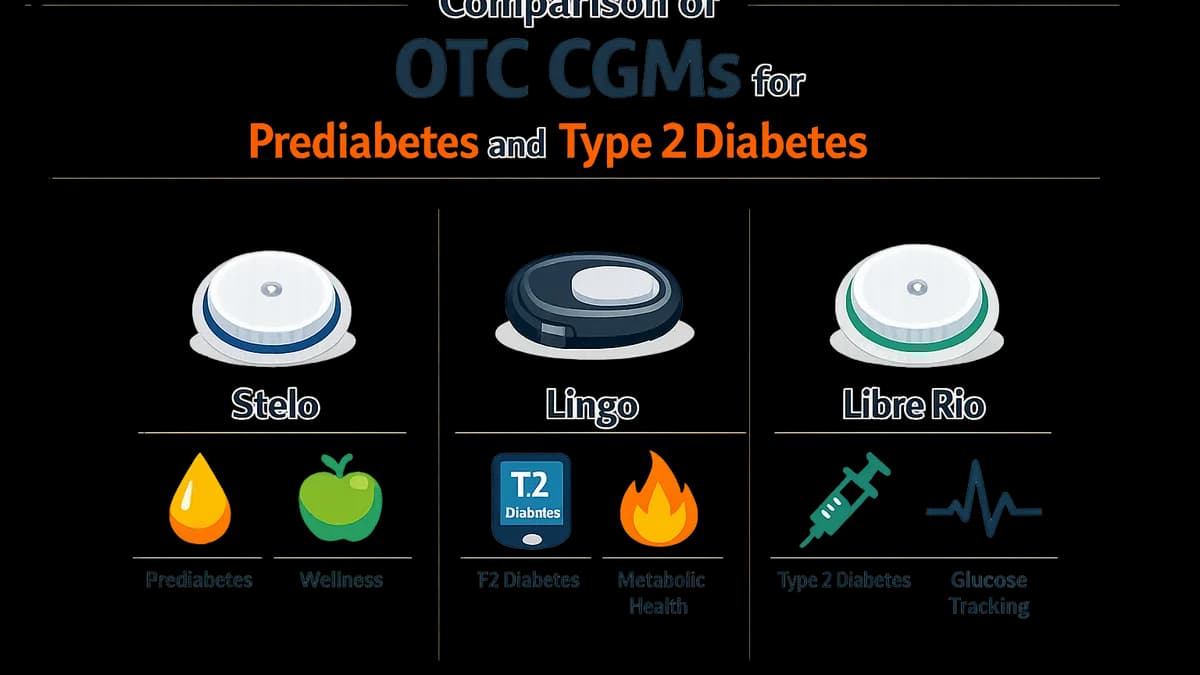
The three OTC CGMs currently available in the U.S. are Abbott's Lingo and Libre Rio, and Dexcom's Stelo. Each has a slightly different audience, feature set, and price point. Lingo is marketed toward general wellness and metabolic health coaching. Stelo and Libre Rio are specifically cleared for people with prediabetes or type 2 diabetes not on insulin. All three use a small sensor worn on the upper arm that measures interstitial glucose continuously for 10 to 15 days per sensor, syncing data to a smartphone app.
Research on CGM use in non-insulin populations is still emerging. A pilot randomized controlled trial enrolled 13 participants with prediabetes or type 2 diabetes in an 8-week exercise program, with or without CGM feedback. The group using CGMs showed higher self-monitoring rates and better attendance, suggesting that real-time glucose data may support behavior change even when insulin is not part of the treatment plan. Larger, longer-term studies are needed to confirm whether OTC CGMs lead to sustained improvements in A1C or other metabolic outcomes.
In the sections that follow, we compare the three OTC CGMs side by side—features, accuracy, cost, and user experience—so you can decide which device, if any, fits your monitoring goals and budget.
What Is the Best CGM for Non Diabetics?
Three over-the-counter continuous glucose monitors are now available in the United States without a prescription: Dexcom Stelo, Abbott Lingo, and Abbott Libre Rio. Each targets a different use case, from prediabetes coaching to type 2 diabetes management without insulin. Understanding the differences in features, data access, and price helps you choose the system that fits your situation.
Dexcom Stelo: For Adults 18+ with Prediabetes or Type 2 Without Insulin
Stelo is cleared for adults 18 and older who are not on insulin. It ships as a two-sensor subscription, with each sensor lasting 15 days. The sensor reads glucose every five minutes and sends data to the Stelo app, where you see real-time traces, trends, and daily summaries. The app does not provide structured coaching or meal-logging prompts — it focuses on showing you the data and letting you interpret patterns yourself.
Stelo uses the same core sensor technology as Dexcom's prescription G7 system, but the app experience is simplified. There are no high or low alarms by default, though you can set optional notifications. The device is designed for people who want continuous visibility into glucose patterns without the clinical intensity of a prescription CGM.
Abbott Lingo: Metabolic Coaching for Adults 18+
Lingo is positioned as a metabolic-health coaching tool rather than a diabetes-management device. It is cleared for adults 18 and older who are not on insulin, including people with prediabetes or early type 2 diabetes. Each sensor lasts 14 days, and the app pairs glucose data with structured coaching prompts, meal logging, and daily "glucose spike" summaries.
The Lingo app calculates a proprietary "Lingo Count" score based on the size and frequency of glucose excursions. The system encourages you to log meals, movement, and sleep, then shows how those behaviors correlate with glucose patterns. For a detailed walkthrough of the app's coaching features and whether they add value, see our Abbott Lingo review.
Lingo sensors are sold individually or in multi-sensor packs; there is no mandatory subscription, though bulk purchases reduce the per-sensor cost.
Abbott Libre Rio: For Adults 18+ with Type 2 Diabetes Not on Insulin
Libre Rio is cleared specifically for adults 18 and older with type 2 diabetes who are not using insulin. It is built on the same sensor platform as the prescription FreeStyle Libre systems, with each sensor lasting 14 days. The Rio app provides real-time glucose readings, trend arrows, and historical traces, but no coaching prompts or meal-logging framework.
Rio is sold as a subscription service with automatic sensor shipments every 28 days. The app includes optional high and low glucose notifications, making it more clinically focused than Lingo but less feature-rich than prescription Libre 2 or Libre 3 systems. If you are already familiar with the Libre sensor form factor from a prescription system, Rio offers the same wearing experience without the prior-authorization process.
Data Access and App Differences
All three systems store your glucose data in the manufacturer's cloud and allow you to export reports or share summaries with your care team. Stelo and Rio focus on showing you the trace and letting you draw your own conclusions. Lingo actively prompts you to log context and interpret spikes through the lens of the coaching framework.
None of these systems integrate directly with insulin pumps or automated delivery algorithms — they are read-only monitors, not closed-loop controllers. If you are considering a CGM to support insulin dosing decisions, you need a prescription system like Dexcom G7 or FreeStyle Libre 2, not an OTC device.
Who Should Use These CGMs?
Over-the-counter continuous glucose monitors are designed for people who want to track glucose patterns without a prescription, but they're not for everyone. These devices work best when your diabetes management doesn't involve insulin and you're looking for pattern data rather than real-time alerts to prevent dangerous lows.
People with Prediabetes
If you have an A1C between 5.7 and 6.4, an OTC CGM can show you how your body responds to meals, activity, and stress. The data helps you see which foods spike your glucose and how much movement it takes to bring levels back down. This real-time feedback can be more useful than periodic fingersticks because you catch patterns you'd otherwise miss—like a slow climb after breakfast or a late-night rise.
Type 2 Diabetes Without Insulin
People with type 2 diabetes who manage with metformin, GLP-1 medications, or lifestyle changes alone can use OTC CGMs to monitor how well their current plan is working. You'll see your glucose trends across the day and night, which helps you and your care team decide if your medications need adjusting or if certain meals consistently push you out of range.
These devices are not appropriate if you take insulin—whether basal, bolus, or premixed. Insulin dosing requires real-time alerts for hypoglycemia, which OTC CGMs do not provide. If you're on insulin, you need a prescription CGM with customizable alarms.
People Focused on Metabolic Health
Some users without diabetes wear OTC CGMs to understand their metabolic responses to diet, exercise, and sleep. This group includes athletes optimizing performance, people experimenting with low-carb or ketogenic diets, and anyone curious about how their body handles glucose day to day. The sensors provide data, but they don't diagnose or treat a condition—they're tools for observation.
Who Should Not Use OTC CGMs
- Anyone taking insulin (you need real-time low-glucose alerts)
- People with type 1 diabetes (prescription CGMs are medically necessary)
- Anyone looking for a device to diagnose diabetes (CGMs track trends; diagnosis requires lab tests)
- Users expecting the device to tell them what to eat or how much medication to take (the sensor provides data; your care team provides the plan)
Patient compliance with CGM is high—one study found adherence rates around 90%—but that number reflects people who understand what the device does and doesn't do. If you're unsure whether an OTC CGM fits your situation, ask your doctor or diabetes educator before you buy.
Cost Analysis: Price-Per-Day
Understanding the real cost of over-the-counter CGMs means looking beyond the sticker price. Each system has a different sensor lifespan, subscription model, and total monthly outlay — and because these devices are not yet widely covered by insurance for prediabetes or type 2 diabetes without insulin, most users pay out of pocket.
Breaking Down the Numbers
Stelo sensors last 15 days and are sold in packs of two (one month's supply). The monthly subscription runs approximately $99, which works out to about $3.30 per day. Lingo sensors also last 14 days, with a similar monthly cost structure around $89–$109 depending on the subscription tier, translating to roughly $3.00–$3.60 per day. Libre Rio sensors have a 14-day wear period as well, with pricing that typically falls in the $90–$100 range per month, or about $3.00–$3.30 per day.
All three systems fall into a narrow cost band when calculated per day — between $3.00 and $3.60 — making them comparable in affordability. The choice often comes down to app features, coaching support, and whether the system's data presentation aligns with your goals rather than a significant price difference.
Insurance and Reimbursement
Current insurance eligibility criteria for CGMs are built around insulin use and certain high-risk conditions. For people with prediabetes or type 2 diabetes managed with oral medications alone, coverage remains limited. Some employers offer wellness benefits or HSA/FSA eligibility that may offset the cost, but direct insurance reimbursement for OTC CGMs in this population is not yet standard.
If you're using an HSA or FSA, verify that your plan administrator considers CGMs an eligible expense. Many do, but policies vary. Keep receipts and any clinical documentation that shows the device was recommended as part of your diabetes prevention or management plan.
Long-Term Value
While $90–$110 per month is a real expense, consider what you're gaining: continuous visibility into how food, activity, stress, and sleep affect your glucose in real time. For someone working to prevent type 2 diabetes or to optimize control without adding medications, that data can inform decisions that reduce future costs — fewer medications, fewer complications, and better overall metabolic health. The investment is in learning patterns that persist even after you stop wearing the sensor.
If cost is a barrier, some users wear a CGM intermittently — one month on, one or two months off — using the data they collect to build sustainable habits, then checking in periodically to confirm those habits are holding. This approach reduces the annual cost while still providing actionable insights.
Conclusion and Recommendations
The arrival of over-the-counter continuous glucose monitors has opened a new pathway for people with prediabetes and type 2 diabetes who don't use insulin. Stelo, Lingo, and Libre Rio each offer real-time glucose visibility without a prescription, and each takes a different approach to cost, coaching, and data presentation. Your choice depends on whether you prioritize affordability, structured behavior-change guidance, or integration with existing Abbott devices.
For most people with prediabetes looking for the lowest barrier to entry, Stelo offers the most straightforward value: $89 per month for two sensors, FDA clearance for the prediabetes indication, and a simple app that flags highs and lows without requiring a separate subscription. If you want metabolic coaching and are willing to pay for it, Lingo pairs the same sensor hardware with daily missions and personalized feedback at $49 per sensor or $299 for a six-pack. If you're already in the Abbott ecosystem and managing type 2 diabetes without insulin, Libre Rio delivers the familiar Libre 2 form factor at $49 per sensor with the option to share data with a care team.
No OTC CGM replaces medical advice or a diagnostic test. These devices show you glucose patterns in real time, but they don't diagnose diabetes, set treatment targets, or tell you when to start medication. If your traces consistently show elevated readings or frequent spikes, bring the data to your next appointment and confirm your A1C and fasting glucose numbers with your care team. CGM is a visibility tool, not a substitute for clinical oversight.
What the Research Shows
Continuous glucose monitoring has demonstrated measurable benefits in clinical populations, and those findings inform what we can expect from OTC use. In people with type 1 diabetes using CGM, the proportion experiencing severe hypoglycemia dropped from 79% to 31%, and broader evidence suggests CGM improves glycemic control, quality of life, and long-term vascular outcomes. The technology is most effective when paired with behavior change—seeing a glucose spike after a meal only helps if you adjust the meal next time.
For prediabetes and early-stage metabolic dysfunction, CGM's role is still emerging. The devices are accurate within the 80–200 mg/dL range where most non-insulin users spend their time, and they surface patterns that fingerstick testing misses—overnight glucose creep, delayed spikes from high-fat meals, and the cumulative effect of sedentary days. But CGM does not directly measure beta cell health or insulin resistance, which remain the clinical markers that guide diagnosis and treatment. Use the trace to inform daily decisions; use lab work and clinical assessment to guide long-term strategy.
Final Recommendations
- If cost is the primary concern, choose Stelo at $89/month for two sensors.
- If you want structured coaching and can budget $299 for six sensors, try Lingo's behavior-change missions.
- If you're already using Abbott devices or managing type 2 without insulin, Libre Rio at $49/sensor integrates with the LibreView ecosystem.
- If you're uncertain, start with a one-month trial of Stelo or a single Libre Rio sensor before committing to a bulk purchase.
CGM won't reverse prediabetes or replace the need for medication if your care team recommends it, but it can make invisible glucose dynamics visible and give you a feedback loop that fingerstick testing cannot. Pair the data with your care team's guidance, and use it as one input among many—not the only one.
FAQ
Do I need a prescription for the best CGM for non diabetics?
No. Stelo, Lingo, and Libre Rio are all FDA-cleared over-the-counter devices available without a prescription for adults 18 and older with prediabetes or type 2 diabetes who do not use insulin.
How accurate are OTC CGMs compared to prescription models?
OTC CGMs use the same sensor technology as their prescription counterparts. Stelo shares core components with Dexcom G7, and Libre Rio and Lingo use the FreeStyle Libre platform. Accuracy is comparable within the 80–200 mg/dL range where most non-insulin users operate.
Can I use an OTC CGM if I'm on metformin or GLP-1 medications?
Yes. OTC CGMs are cleared for people with type 2 diabetes who do not take insulin. Metformin, GLP-1 receptor agonists, SGLT2 inhibitors, and other non-insulin medications do not disqualify you from using these devices.
Will insurance cover the best CGM for non diabetics?
Most commercial insurance plans and Medicare do not currently cover OTC CGMs for prediabetes or type 2 diabetes without insulin use. Some HSA and FSA plans may reimburse the cost; check with your plan administrator.
How long does each sensor last?
Stelo sensors last 15 days. Lingo and Libre Rio sensors each last 14 days. All three systems require you to replace the sensor at the end of its wear period.
Discover the best OTC CGMs for prediabetes & type 2 diabetes without insulin or prescription.

Maren Alcott is the lead presenter at DiabetesCompass. She is an AI-presented digital character. Every article Maren presents is researched and fact-checked by the DiabetesCompass editorial team against the ADA Standards of Care, peer-reviewed journals, and named clinical sources. Maren does not give medical advice — for questions about your specific situation, talk to your care team.