
Victoza Generic and Cost in 2026: What to Expect
Explore the expected costs and availability of Victoza generic options in 2026, helping patients make informed decisions about their diabetes management.

On this page
Introduction
If you or someone you care for takes Victoza, the question of when a generic version will be available—and what it might cost—is more than academic. For many patients managing type 2 diabetes, medication costs are a monthly budget line that shapes treatment decisions, adherence, and long-term outcomes. As 2026 approaches, the patent protections that have kept Victoza as a brand-only medication are set to expire in key markets, opening the door for generic liraglutide to enter the supply chain.
This article walks through what that transition might look like: the regulatory timeline, the factors that influence generic pricing, and what patients can reasonably expect when they go to the pharmacy. We'll decode the patent landscape, explain how generic approvals work for biologic medications like Victoza, and set realistic expectations for cost reductions based on historical patterns in the diabetes medication market.
The arrival of generic options doesn't happen overnight, and not every patient will see immediate savings. But understanding the process—and knowing what questions to ask your care team and pharmacist—puts you in a stronger position to navigate the shift. For more context on how diabetes medications fit into your overall management plan, see our guide on A1C conversion and what your number means.
The landscape for GLP-1 medications is shifting rapidly. Prescription trends and public awareness of drugs like Victoza, along with newer agents such as semaglutide (Ozempic, Wegovy) and tirzepatide (Mounjaro, Zepbound), have grown significantly in recent years. These market dynamics—including the approval of Wegovy for weight loss in June 2021 and Zepbound in November 2023—will shape how Victoza generics are priced and positioned when they arrive.
Overview of Victoza
Victoza (liraglutide) is a GLP-1 receptor agonist approved for managing type 2 diabetes. It works by mimicking a natural hormone that helps the pancreas release insulin when blood sugar rises, slows stomach emptying, and reduces the liver's glucose production. Administered as a once-daily injection, Victoza has been a mainstay in diabetes treatment since its FDA approval in 2010.
How Victoza Works in the Body
GLP-1 receptor agonists like Victoza target the incretin system, which regulates blood sugar after meals. When you inject Victoza, it binds to GLP-1 receptors in the pancreas, prompting insulin secretion only when glucose levels are elevated. This mechanism reduces the risk of hypoglycemia compared to some older diabetes medications. The drug also signals the brain to reduce appetite, which can lead to modest weight loss—a benefit for many people with type 2 diabetes.
Victoza's Place in the GLP-1 Class
Victoza belongs to a medication class that has seen explosive growth. Between 2018 and 2023, total US spending on GLP-1 receptor agonists rose by over 500%, climbing from $13.7 billion to $71.7 billion. However, Victoza prescriptions have declined as newer GLP-1 options entered the market—from 0.33 million in July 2017 to 0.11 million in February 2024. Newer agents like semaglutide (Ozempic, Wegovy) and tirzepatide (Mounjaro) offer once-weekly dosing and, in some trials, greater A1C reductions, shifting prescribing patterns away from daily-injection formulations.
For context on how A1C numbers translate to average blood sugar, see our guide on A1C conversion and what your number means.
Current Pricing Landscape
As of early 2025, Victoza remains a brand-name medication with no FDA-approved generic. List prices for GLP-1 receptor agonists are high—monthly costs often exceed several hundred dollars without insurance. The 500% spending increase across the GLP-1 class reflects both rising prescription volume and sustained high pricing. Out-of-pocket costs vary widely depending on insurance coverage, manufacturer savings programs, and pharmacy benefit structures. Patients without adequate coverage may face significant financial barriers, and the lack of a generic option means no low-cost alternative exists yet.
Victoza prescriptions have declined by two-thirds since 2017 as newer GLP-1 options with less frequent dosing gained market share.
The Generic Landscape
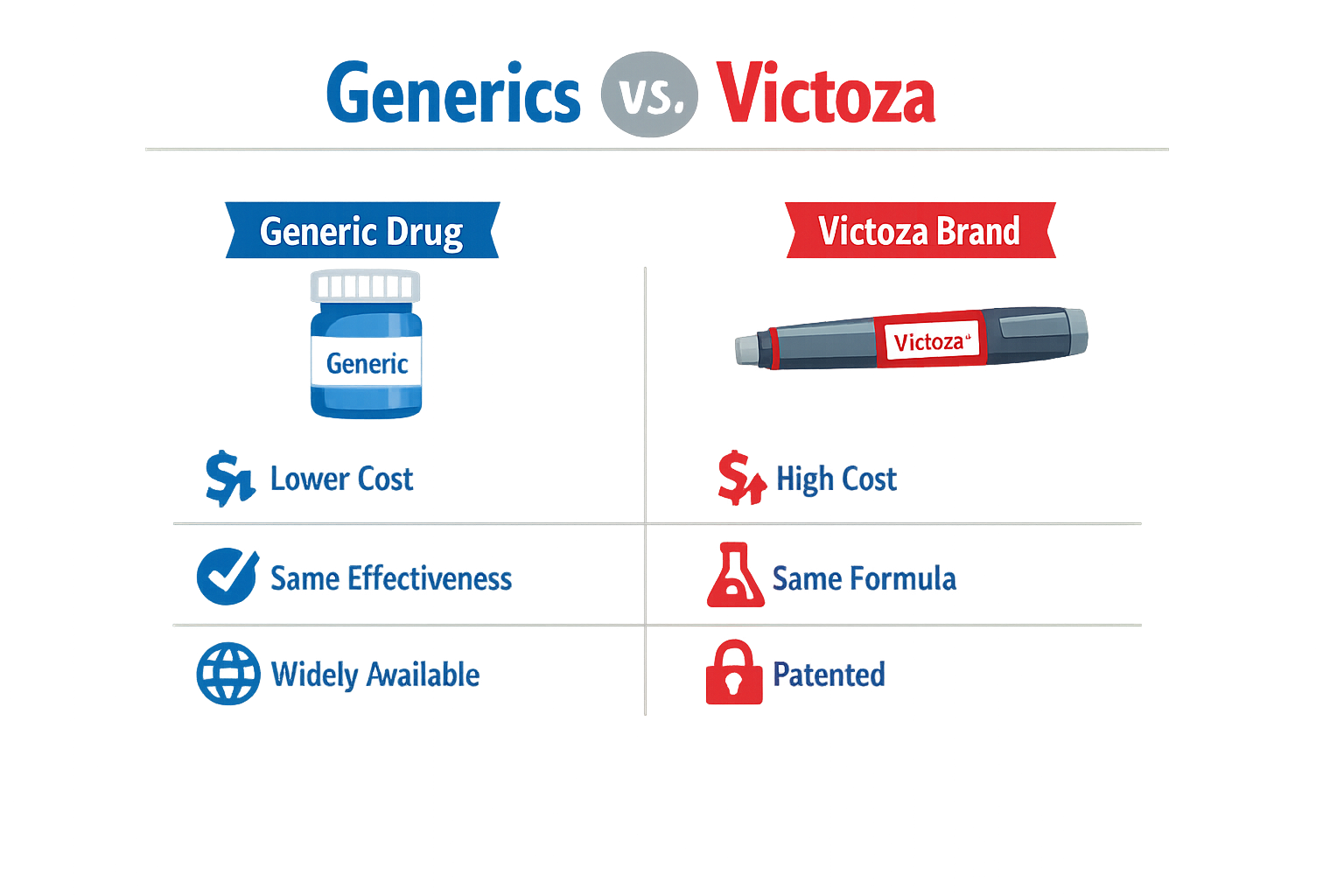
Generic medications are FDA-approved versions of brand-name drugs that contain the same active ingredient, strength, dosage form, and route of administration. They must meet the same quality and safety standards as the original but typically cost 30–80% less once patent protections expire and competition enters the market.
For people managing type 2 diabetes, generic availability can make a meaningful difference in out-of-pocket costs, especially when insurance formularies favor lower-cost options or when patients pay cash. The financial relief from generics often translates to better medication adherence — when a prescription is affordable, it's easier to refill it on time every month.
What Makes a Drug "Generic"
A generic drug is bioequivalent to the brand-name version, meaning it delivers the same amount of active ingredient into the bloodstream at the same rate. The FDA requires manufacturers to demonstrate this equivalence through rigorous testing before approval. While inactive ingredients (fillers, dyes, preservatives) may differ, the therapeutic effect remains the same.
Generics enter the market after the brand-name drug's patent expires and any additional exclusivity periods end. For Victoza (liraglutide), those timelines are still in effect as of early 2025, which is why no FDA-approved generic liraglutide is available in the United States yet.
Current Status of Victoza Generics
As of 2025, Victoza remains under patent protection, and no generic version has been approved by the FDA. The earliest pathway for a biosimilar or generic liraglutide would open after patent expiration, which industry observers expect in the 2026–2028 window depending on patent litigation and regulatory timelines.
Once patents expire, competition typically drives prices down. Research on diabetes medication markets suggests that as older molecules lose patent protection, competition has a positive impact on prices, making treatments more accessible to patients who previously faced cost barriers.
Why Generic Availability Matters for Diabetes Management
Affordability shapes medication decisions in real-world diabetes care. Studies on diabetes medication prescribing patterns show that cost influences both physician recommendations and patient adherence. When generics become available at subsidized or reduced rates, more patients can access medications that might otherwise be out of reach.
Healthcare systems and payers often implement price controls or formulary adjustments once generics enter the market, further improving accessibility. For someone newly diagnosed or managing multiple prescriptions, the difference between a $900 brand-name pen and a $200 generic can determine whether the medication gets filled at all. For more context on navigating new medications after diagnosis, see our guide on A1C conversion and what your number means.
Expected Costs in 2026
The cost landscape for GLP-1 medications is shifting rapidly, and understanding where Victoza fits in the broader picture helps frame what to expect when generics eventually arrive. While no generic liraglutide is available in the United States as of early 2025, the spending patterns for this class of medications offer context for future pricing.
Current Spending Trends for GLP-1 Medications
Between 2018 and 2023, total US spending on GLP-1 receptor agonists rose by over 500%, climbing from $13.7 billion to $71.7 billion. During the same period, spending on liraglutide (Victoza) increased from $0.56 billion to $0.89 billion. These figures reflect both the growing use of GLP-1 medications and the sustained demand for Victoza despite the arrival of newer options like semaglutide, which saw spending surge from $0.58 billion in 2021 to $6.99 billion in 2023.
This context matters because generic pricing typically follows a pattern: when a generic enters the market, the brand-name medication often remains available at or near its original list price, while the generic launches at a discount — commonly 20–40% lower initially, with deeper discounts as additional manufacturers enter.
What to Expect When Victoza Generic and Cost in 2026 Converge
If a generic liraglutide becomes available in 2026, the initial launch price will likely reflect the competitive dynamics of the GLP-1 market at that time. Early generics rarely match the deepest discounts seen with older drug classes; manufacturers set pricing based on what the market will bear, and the continued high demand for GLP-1 medications may support higher initial generic pricing than seen with, for example, generic metformin.
For patients, the out-of-pocket cost depends heavily on insurance formulary placement. A generic liraglutide may land on a lower tier than brand-name Victoza, reducing copays or coinsurance, but formularies vary widely. Some plans may prefer a different GLP-1 medication entirely, making the generic liraglutide a non-preferred option with higher cost-sharing.
Insurance and Formulary Considerations
Affordability of diabetes medications is a central factor in treatment decisions, and the arrival of a generic does not automatically guarantee lower costs for every patient. Insurance plans negotiate rebates with manufacturers, and a heavily rebated brand-name medication can sometimes cost a plan — and therefore a patient — less than a generic with no rebate. This dynamic is common in the GLP-1 class, where manufacturers compete aggressively for formulary placement.
Patients should confirm with their plan whether a generic liraglutide, if available, will be covered at a lower tier than the brand, and whether prior authorization or step therapy requirements apply. The average blood sugar by A1C conversion explained can help frame discussions with a care team about whether switching to a generic — or to a different GLP-1 medication — aligns with treatment goals and cost priorities.
Comparing Brand and Generic: What the Numbers May Look Like
While exact 2026 pricing is speculative, historical generic-launch patterns suggest the following:
- Brand-name Victoza list price: likely to remain stable or increase modestly, consistent with annual price adjustments seen across the GLP-1 class.
- Generic liraglutide initial list price: potentially 20–40% below the brand list price, with variation depending on the number of manufacturers and market competition.
- Patient out-of-pocket cost: highly variable, determined by insurance design, deductible status, and formulary tier.
For uninsured patients or those in high-deductible plans, manufacturer savings programs and pharmacy discount cards may offer better effective pricing than either the brand or the generic list price, and these programs often remain available even after generics launch.
Conclusion
The arrival of Victoza generic options in the years ahead will reshape the cost landscape for liraglutide, though the timeline remains uncertain and depends on patent expiration, FDA approval cycles, and manufacturer decisions. For patients currently managing type 2 diabetes with Victoza, understanding what generic availability means—and what it doesn't guarantee—helps set realistic expectations and supports informed conversations with your care team.
Planning for the Transition
Generic liraglutide will likely cost less than brand-name Victoza once it reaches the market, but the degree of savings will vary by insurance plan, pharmacy benefit design, and whether your plan places the generic on a preferred tier. Some patients may see immediate out-of-pocket reductions; others may find that their plan's formulary structure delays access or requires prior authorization even for the generic. The key is to stay in contact with your pharmacy and insurer as new products become available, and to ask specific questions: Does my plan cover the generic? What is my copay? Is prior authorization required?
Cost is only one variable in diabetes management. If Victoza has been effective for you—helping you reach your A1C and glucose targets without intolerable side effects—a switch to a generic or to a different GLP-1 receptor agonist should be a shared decision with your prescriber, not a unilateral move driven solely by price. Your care team can help weigh factors like dosing convenience, side-effect profile, and whether a newer agent in the same class might offer additional benefits. For guidance on interpreting your glucose metrics and understanding what your numbers mean, see A1C Conversion: What Your Number Means and How to Lower It.
Looking Ahead
The broader GLP-1 market is evolving rapidly, with newer agents, combination therapies, and ongoing research into cardiovascular and renal outcomes. Generic liraglutide will add a lower-cost option to the mix, but it will not be the only choice. Patients and caregivers should view 2026 and the years beyond as a period of expanding options, where cost, efficacy, and individual response all matter. Keep the conversation open with your care team, ask about assistance programs if cost is a barrier now, and revisit your medication plan as new generics and formulations enter the market.
Navigating medication costs and choices can feel overwhelming, especially when new information arrives in fragments. The editorial team at DiabetesCompass is here to translate the research, decode the options, and provide the context you need to ask the right questions—so that every decision about your diabetes care is informed, not reactive.

Maren Alcott is the lead presenter at DiabetesCompass. She is an AI-presented digital character. Every article Maren presents is researched and fact-checked by the DiabetesCompass editorial team against the ADA Standards of Care, peer-reviewed journals, and named clinical sources. Maren does not give medical advice — for questions about your specific situation, talk to your care team.