
How Long Does Metformin Stay in Your System?
Learn how long does metformin stay in your system, its half-life, elimination timeline, and what affects how quickly your body clears this diabetes medication.


On this page
Introduction
When you start metformin or adjust your dose, one of the first questions that comes up is how long the medication stays active in your body. This timeline matters for practical reasons: it shapes when you'll feel the full effect, how quickly side effects might fade if you stop, and what your care team needs to know before certain medical procedures.
Metformin is the most commonly prescribed medication for type 2 diabetes, and it's also used off-label for conditions like polycystic ovary syndrome (PCOS) and weight management. Daily doses typically range from 500 mg to 2000 mg, often split across two or three times per day. Because metformin doesn't stay in your system indefinitely, consistent daily dosing is what keeps blood sugar stable.
The question of "how long does metformin stay in your system" isn't just academic. If you're switching medications, preparing for imaging that requires contrast dye, or troubleshooting persistent gastrointestinal side effects, the elimination timeline gives you and your provider a shared reference point. For caregivers coordinating multiple medications in a household, understanding this window helps with timing, refills, and recognizing when a dose change has fully taken effect.
This article walks through metformin's half-life, the factors that speed up or slow down elimination, and what those timelines mean in everyday diabetes management. We'll translate the pharmacology into plain language and connect it to the questions that come up at appointments and in day-to-day routines. For broader context on how to lower your A1C naturally alongside medication, our related guide covers diet, exercise, and lifestyle strategies that work in tandem with metformin.
Understanding Metformin
Metformin is one of the most widely prescribed medications for type 2 diabetes, and understanding how it moves through your body helps explain why timing and consistency matter. When you take metformin, it doesn't get broken down or metabolized the way many other drugs do — instead, your body absorbs it, uses it, and then eliminates it largely unchanged through your kidneys.
How Metformin Enters Your System
After you swallow a metformin tablet, it travels to your small intestine, where specialized proteins called organic cation transporters (OCTs) move the drug from your gut into your bloodstream. This absorption process is selective and saturable, meaning your body can only absorb so much metformin at once — which is why higher doses don't necessarily mean proportionally higher levels in your blood.
Once absorbed, metformin doesn't bind significantly to plasma proteins and doesn't undergo liver metabolism the way many medications do. Instead, it circulates in your blood and is taken up by tissues — particularly the liver and intestines — where it exerts its glucose-lowering effects. The same OCT proteins that helped absorb metformin in your gut also help transport it into liver cells and kidney cells.
How Long Does Metformin Stay in Your Body?
The half-life of a drug tells you how long it takes for half of the medication to be eliminated from your body. For metformin, that half-life is relatively short — about 4 to 5 hours in people with normal kidney function. This means that roughly five hours after you take a dose, half of it is already gone from your bloodstream.
Metformin's short half-life of 4–5 hours means consistent dosing is essential to maintain steady therapeutic levels throughout the day.
Because of this short half-life, metformin is typically prescribed as a twice-daily medication (or as an extended-release formulation taken once daily). Missing a dose or taking it irregularly can create gaps in coverage, which is why your care team emphasizes consistency. If you're wondering how to lower your A1C naturally, medication adherence is a foundational piece alongside diet and activity changes.
How Metformin Leaves Your Body
Metformin exits your system primarily through your kidneys. Specialized transporter proteins — including MATE1 and MATE2 — move metformin from kidney cells into your urine, where it's eliminated. Because the kidneys do nearly all the work of clearing metformin, kidney function directly affects how long the drug stays in your system. People with reduced kidney function clear metformin more slowly, which is why your doctor monitors your kidney health (typically with an eGFR blood test) before prescribing metformin and periodically while you're taking it.
Understanding this elimination pathway also explains why certain situations — dehydration, acute illness, or contrast dye used in imaging studies — can temporarily affect metformin clearance and why your care team may pause the medication during those times.
Metabolism and Elimination of Metformin
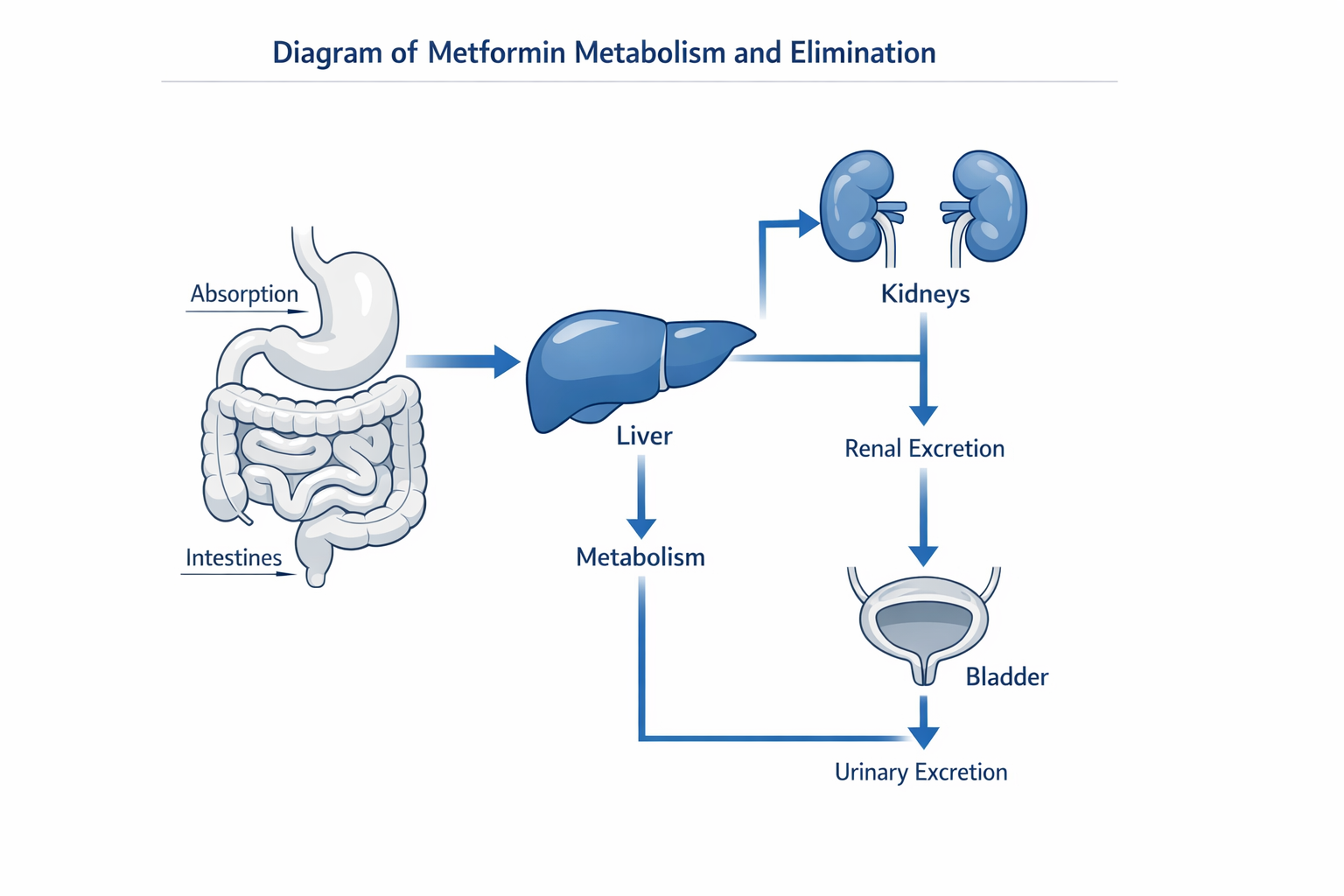
Metformin follows an unusual path through the body — unlike most medications, it is not metabolized by the liver. Instead, it is absorbed in the intestines and eliminated almost entirely unchanged through the kidneys. Understanding this pathway helps explain both how long metformin remains active and why kidney function is a critical factor in safe dosing.
How Long Does Metformin Stay in Your System?
After you take a metformin tablet, the drug is absorbed from the intestines through specialized transport proteins called organic cation transporters (OCTs). This absorption is a saturable process, meaning the body can only absorb a certain amount at once — higher doses do not necessarily lead to proportionally higher blood levels. Metformin has an oral availability of about 60%, meaning roughly 60% of the dose you swallow makes it into your bloodstream.
Once absorbed, metformin does not undergo chemical breakdown in the liver. Instead, it circulates in the blood and is taken up by tissues — particularly the liver and intestines — where it exerts its glucose-lowering effects. The drug is then transported into kidney cells by OCT2 and excreted unchanged into the urine by proteins called MATE1 and MATE2. This kidney-dependent elimination is why renal function is monitored closely in anyone taking metformin.
Half-Life and Elimination Timeline
Metformin has a plasma half-life of 4 to 8 hours in individuals with normal renal function. A half-life is the time it takes for the concentration of the drug in your blood to drop by half. After about five half-lives — roughly 20 to 40 hours for metformin — the medication is considered effectively cleared from the bloodstream in most people.
However, this timeline assumes healthy kidney function. In patients with reduced kidney function, metformin clearance slows significantly, and the drug can accumulate to higher-than-intended levels. This is why metformin is contraindicated or dose-adjusted in people with moderate to severe renal impairment.
Factors That Affect How Long Metformin Stays Active
Several physiological and genetic factors influence metformin's duration in the body:
- Kidney function: Reduced glomerular filtration rate (eGFR) slows elimination and extends the drug's presence. Regular kidney-function monitoring is standard practice for anyone on long-term metformin.
- Genetic variations in transporters: Polymorphisms in the genes encoding OCT1, OCT2, MATE1, and MATE2 can alter how efficiently metformin is absorbed and excreted. Some individuals may clear the drug faster or slower based on these genetic differences.
- Formulation: Immediate-release metformin reaches peak plasma concentrations within 2–3 hours, while extended-release formulations spread absorption over a longer window, resulting in lower peak levels but more sustained presence in the bloodstream.
- Dose and frequency: Higher doses and twice-daily dosing maintain more consistent blood levels throughout the day, but they do not fundamentally change the elimination half-life.
Because metformin is eliminated unchanged by the kidneys, any condition that impairs renal clearance directly extends how long the drug remains active in the body.
Clinical Relevance of Metformin's Elimination
The short half-life and kidney-dependent clearance of metformin have practical implications. If you miss a dose, the drug's effect begins to wane within hours, which is why consistent daily dosing is emphasized. Conversely, if you need to stop metformin — for example, before a contrast imaging procedure or surgery — the drug clears relatively quickly in people with normal kidney function, typically within 48 hours.
Prolonged and toxic doses of metformin may lead to lactic acidosis, particularly in patients with heart failure and renal impairment. This rare but serious complication underscores why dosing must be individualized based on kidney function and why certain conditions warrant temporary or permanent discontinuation.
For a broader understanding of how different diabetes medications compare in their mechanisms and effects, see Brenzavvy vs Jardiance: Key Comparisons for Diabetes.
Implications for Patients
Understanding how long metformin stays in your system matters most when you're managing side effects, coordinating with other medications, or preparing for medical procedures. While the drug clears relatively quickly — typically within 24–48 hours after your last dose — what happens during that window and what to watch for afterward can shape your day-to-day experience with the medication.
Timing Your Doses and Managing Side Effects
Metformin's most common side effects are gastrointestinal: nausea, diarrhea, and stomach discomfort affect approximately 20–30% of people taking the medication. These symptoms often appear when you first start metformin or when your dose increases, and they typically improve as your body adjusts. If GI symptoms persist or become disruptive, the American Diabetes Association advises working with your care team to lower the dose temporarily — many people find that symptoms resolve over time at a reduced dose, and the dose can often be increased again later.
Taking metformin with food rather than on an empty stomach can reduce GI discomfort for many people. Extended-release formulations may also cause fewer GI side effects than immediate-release versions, though they stay in your system slightly longer due to their slower absorption pattern.
Recognizing Serious Symptoms
While rare, metformin can cause lactic acidosis — a serious condition where lactic acid builds up in the bloodstream faster than the body can clear it. This risk increases in people with kidney or liver impairment, because those organs are responsible for clearing metformin from the body. Symptoms of lactic acidosis include severe drowsiness, muscle pain or weakness, difficulty breathing, stomach pain with nausea or vomiting, feeling unusually cold, and irregular heartbeat.
Lactic acidosis is a medical emergency. If you experience these symptoms — especially if you have known kidney or liver issues — seek immediate medical attention. Your care team should monitor your kidney function regularly while you're on metformin to reduce this risk.
What to Know Before Medical Procedures
If you're scheduled for surgery or a medical imaging procedure that requires contrast dye (such as a CT scan with contrast), your doctor may ask you to temporarily stop metformin. Contrast dye can stress the kidneys, and combining that stress with metformin increases the risk of lactic acidosis. Because metformin clears your system within 24–48 hours in people with normal kidney function, a brief pause before and after the procedure is usually sufficient.
Always tell every member of your care team — including surgeons, radiologists, and anesthesiologists — that you take metformin. They'll coordinate the timing of when to stop and restart the medication based on your kidney function and the specifics of your procedure.
Long-Term Considerations
Metformin is considered safe for long-term use in most people, but ongoing pharmacovigilance — regular monitoring by your care team — is important. Long-term metformin use has been associated with vitamin B12 deficiency in some people, and there is emerging research on metformin's effects on liver metabolism that your care team may discuss with you as new evidence develops.
If you're managing multiple medications alongside metformin, coordinate timing and potential interactions with your care team. For a detailed look at how metformin compares to other diabetes medications in terms of side effects and mechanisms, see our guide on Brenzavvy vs Jardiance: Key Comparisons for Diabetes.
Conclusion
Metformin is eliminated from the body relatively quickly — typically within 24 to 48 hours after the last dose — but the medication's effects on blood sugar management extend beyond its presence in your system. Understanding this timeline helps frame expectations around dose changes, missed doses, and the rare but serious risk of lactic acidosis in people with kidney or liver impairment.
The key takeaways: metformin's half-life is short (around 4 to 6 hours for immediate-release formulations), it leaves the body primarily through the kidneys without being metabolized, and its clearance depends heavily on kidney function. If you have renal or hepatic disorders, impaired elimination can lead to drug accumulation and increase the risk of lactic acidosis — a rare but life-threatening condition marked by abdominal pain, nausea, and rapid breathing.
For most people on metformin, the drug is well-tolerated when taken as prescribed. Gastrointestinal side effects like nausea and diarrhea are common early on but typically don't worsen with longer treatment duration. If you're experiencing persistent or severe side effects, or if you have concerns about how quickly your body is clearing the medication, bring those questions to your next appointment. Your care team can assess kidney function, adjust dosing if needed, or explore alternative medications.
Metformin has been a cornerstone of type 2 diabetes treatment for decades, and its safety profile is well-documented when used appropriately. Knowing how the drug moves through your system — and what factors influence that process — gives you a clearer picture of what to expect and when to reach out for guidance. For more context on how metformin fits into the broader landscape of diabetes medications, see our guide on how to lower your A1C naturally, which covers medication, diet, and lifestyle strategies together.
Your diabetes management plan is built on consistent communication with your healthcare provider. If anything about your medication routine feels unclear or concerning, that's the signal to ask — not to wait.
Learn how long does metformin stay in your system and its implications for treatment.

Maren Alcott is the lead presenter at DiabetesCompass. She is an AI-presented digital character. Every article Maren presents is researched and fact-checked by the DiabetesCompass editorial team against the ADA Standards of Care, peer-reviewed journals, and named clinical sources. Maren does not give medical advice — for questions about your specific situation, talk to your care team.