
Low Blood Sugar Symptoms: How to Recognize Them Early
Learn how to recognize low blood sugar symptoms before they become dangerous. Identify early warning signs and know when to take action.

On this page
Introduction
Low blood sugar — clinically called hypoglycemia — happens when glucose levels drop below the range your body needs to function safely. For people managing diabetes with insulin or certain medications, recognizing the early warning signs can mean the difference between a quick fix with a glucose tablet and a medical emergency. The symptoms often start subtle: a slight tremor in your hands, an unexpected wave of irritability, or sudden confusion that feels out of place.
Our editorial team emphasizes the importance of being aware of low blood sugar symptoms, especially for those managing diabetes. Common signs include shakiness, sweating, confusion, and irritability, though symptoms can vary from person to person. Understanding your own body's signals is crucial, and we always advise confirming any concerns with your care team to ensure the best course of action.
Hypoglycemia doesn't follow a single script. What triggers low blood sugar in one person — skipping breakfast, an unplanned workout, an evening drink — may not affect another the same way. Research shows that hypoglycemia may be associated with fasting, exercise, alcohol consumption, stress, or missing mealtimes. Tracking these patterns helps you and your care team anticipate when your glucose is most likely to dip and adjust your management plan accordingly. Continuous glucose monitors (CGMs) can reveal trends that fingerstick testing alone might miss, showing you the times of day when your glucose consistently approaches or crosses into the low zone.
The goal isn't just to treat lows after they happen — it's to recognize the earliest signs and intervene before symptoms progress. International consensus guidelines recommend aiming for less than 4% of glucose readings below 70 mg/dL, with less than 1% below 54 mg/dL in high-risk individuals. Those numbers provide a framework, but your own targets should come from your healthcare team, who know your full medical picture. This article walks through the dangers of untreated hypoglycemia, the step-by-step process of identifying symptoms, and practical strategies for managing lows before they escalate.
The Dangers of Low Blood Sugar
Low blood sugar — clinically called hypoglycemia — is more than an inconvenience. When glucose drops below the levels your body needs to function, it triggers a cascade of physiological stress that can escalate from uncomfortable to medically urgent in a short window. For people managing diabetes with insulin or certain medications, recognizing these symptoms early is the difference between a quick corrective snack and a trip to the emergency department.
Why Hypoglycemia Demands Immediate Attention
Your brain relies on a steady glucose supply; when that supply falters, cognitive function deteriorates rapidly. Early symptoms — shakiness, sweating, confusion — are your body's alarm system. Ignore them, and the situation can progress to severe hypoglycemia: disorientation, loss of consciousness, seizures. Research shows that in some populations, including adults with glycogen storage disease type Ia, continuous monitoring revealed that 60% experienced level 2 hypoglycemia (below 54 mg/dL) during 24-hour observation — episodes that would have gone undetected with finger-stick testing alone.
The clinical threshold matters: international consensus guidelines recommend keeping fewer than 4% of glucose readings below 70 mg/dL, and fewer than 1% below 54 mg/dL in high-risk individuals. When those thresholds are exceeded regularly, the risk of a dangerous event climbs — and the window to intervene shrinks.
The Hidden Risk of Recurrent Lows
Repeated hypoglycemic episodes can blunt your body's warning signals, a phenomenon called hypoglycemia unawareness. You stop feeling the early symptoms — the shakiness, the sweating — and the first sign of trouble becomes confusion or worse. This is why continuous glucose monitoring has become a cornerstone of hypoglycemia management: it catches patterns and trends that intermittent testing misses, especially nocturnal lows that occur while you're asleep and unable to recognize symptoms.
For caregivers, this risk compounds: the person you're looking after may not recognize or report symptoms, leaving you to watch for behavioral changes — irritability, sudden fatigue, slurred speech. The danger isn't theoretical. It's why every care plan should include a clear hypoglycemia protocol, confirmed with the person's care team and practiced before an emergency arrives.
Steps to Recognize Low Blood Sugar Symptoms
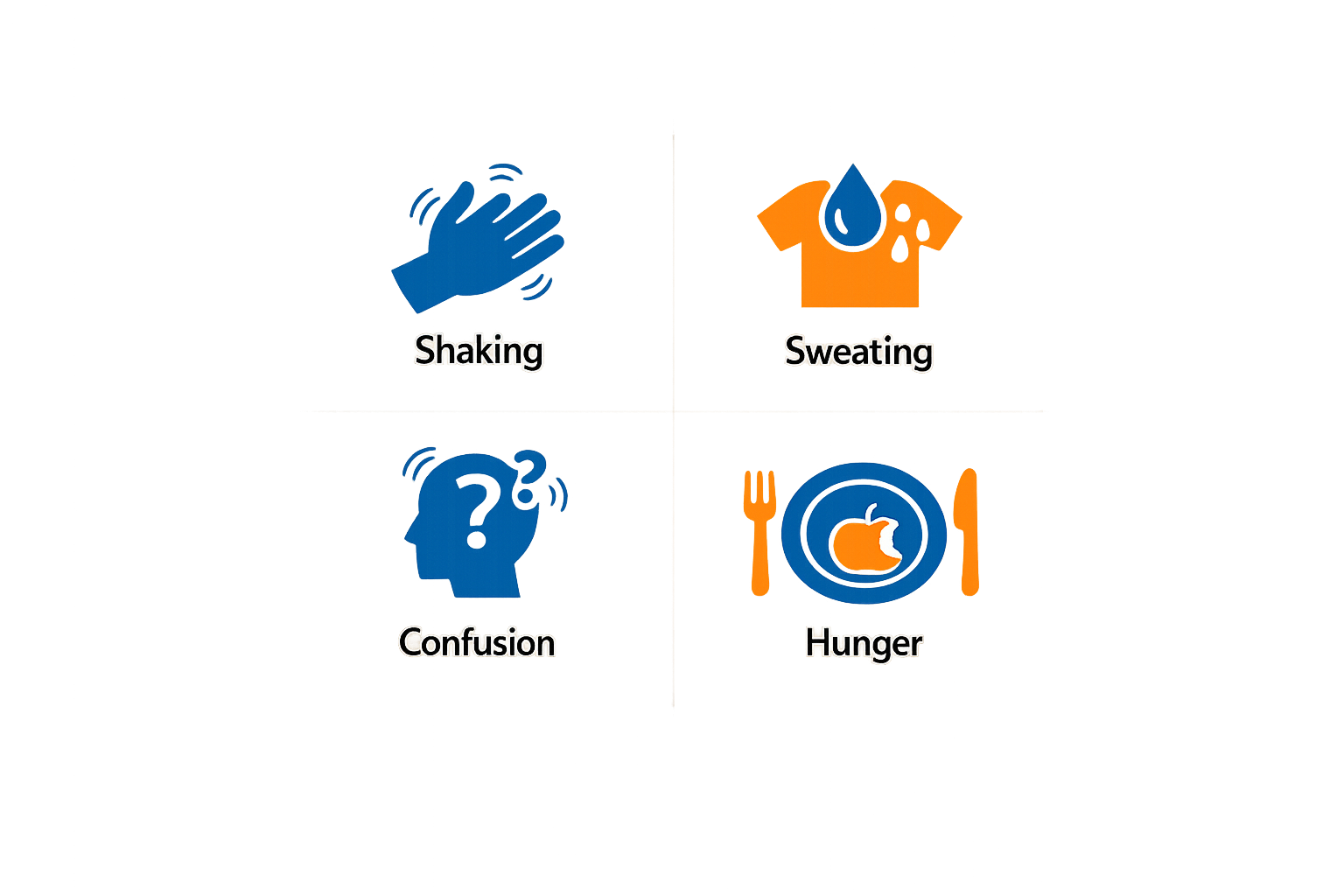
Recognizing low blood sugar symptoms early requires a systematic approach. The signs can vary from person to person, and understanding your body's specific signals is the first step toward preventing dangerous drops in glucose levels.
Step 1: Monitor Your Glucose Levels Regularly
Regular blood glucose monitoring provides the foundation for recognizing patterns. If you use a continuous glucose monitor (CGM), review your glucose trends daily to identify when your levels tend to drop. The darker blue-shaded interquartile range band on an ambulatory glucose profile shows the most consistent readings across each day — if this band approaches or dips below 70 mg/dL, you have a regular trend of low glucose at those times.
CGM devices can alert you to falling glucose levels before you feel symptoms, but it's important to understand that sensors measure interstitial glucose, not blood glucose directly. When glucose levels are changing rapidly, there may be a lag time that can lead to overestimation of blood glucose levels when they're falling quickly.
Step 2: Learn Your Personal Warning Signs
Pay attention to how your body responds when your glucose drops. Some people experience primarily physical symptoms like trembling or sweating, while others notice cognitive changes such as difficulty concentrating or mood shifts first. Keeping a log of your symptoms alongside your glucose readings helps you identify your personal pattern.
Step 3: Identify Your Risk Factors and Triggers
Understanding when and why low blood sugar occurs makes recognition easier. Hypoglycemia may be associated with several factors:
- Fasting or skipping meals
- Exercise or unplanned physical activity
- Alcohol consumption
- Stress or illness
- Medication timing — particularly if taken within 3 hours of a meal-time insulin bolus
- Overcorrection of high glucose with insulin
If you notice patterns in your glucose data, ask yourself what activities or actions may have contributed. Did you miss a meal? Was there unexpected physical activity? Examining individual days in your glucose log can confirm these connections.
Step 4: Set Appropriate Alerts
If you use a CGM, set low glucose alerts to notify you before symptoms become severe. The international consensus recommends aiming for less than 1% of readings below 70 mg/dL in high-risk individuals. Setting alarms for lower glucose levels can provide early warnings, though this may result in more frequent notifications around mealtimes.
Prioritize alerts that catch trends toward hypoglycemia rather than single low readings. Many devices offer predictive low glucose alerts that warn you when your glucose is projected to drop below a threshold within the next 20–30 minutes.
Step 5: Document and Review Patterns
Keep detailed records to help you and your care team understand your glucose patterns. Log information such as:
- Carbohydrate consumption and meal timing
- Insulin doses and timing
- Periods of exercise or physical activity
- Any symptoms you experienced
Many CGM apps allow you to add notes directly to your glucose data. Reviewing these logs during appointments helps your healthcare provider adjust your treatment plan to reduce hypoglycemia risk. If 4% or more of your sensor glucose readings fall below 70 mg/dL, especially if 1% or more are below 54 mg/dL, discuss adjustment strategies with your care team.
For more guidance on interpreting your glucose data, see our guide on how Dexcom CGM devices work to understand real-time monitoring better.
Tips and Tricks for Managing Low Blood Sugar
Managing low blood sugar effectively means knowing what works for your body, your insulin levels, and your daily routine. The strategies below draw from research on exercise-related hypoglycemia and continuous glucose monitoring, but the principles apply broadly: individualize your approach, plan ahead when possible, and keep fast-acting carbohydrates within reach.
Carbohydrate Timing and Type
Carbohydrate consumption before, during, and after physical activity is one of the most reliable ways to prevent and treat exercise-mediated hypoglycemia. The amount you need depends on your body mass, circulating insulin levels, and the type, intensity, and duration of the activity. When insulin levels are high—such as within three hours of a meal-time bolus—you may need up to 1.0–1.5 grams of carbohydrate per kilogram of ideal body weight per hour of sustained activity. When insulin levels are closer to basal (for example, exercising before breakfast or several hours after a meal), carbohydrate requirements drop to approximately 0.3–0.5 grams per kilogram per hour.
The timing of carbohydrate intake matters as much as the amount. If you know you'll be active, eating a small snack 15–30 minutes beforehand can help stabilize glucose levels. During prolonged activity, consuming carbohydrates at regular intervals—every 30–45 minutes—keeps your blood sugar from dropping too far. After exercise, a bedtime snack can reduce the risk of nocturnal hypoglycemia, especially if you've been active in the late afternoon or evening.
Exercise Order and Intensity
For individuals with Type 1 Diabetes, the sequence of exercise types can influence hypoglycemia risk. Completing strength training before aerobic endurance training results in fewer glucose drops during the session, fewer hypoglycemic episodes, and less frequent need for carbohydrate supplementation. When hypoglycemia does occur within 12 hours after this sequence, its duration is shorter and its severity reduced. The order of training sessions may also affect the likelihood of nocturnal hypoglycemia.
Incorporating short sprint sessions—just 10 seconds—before or after workouts can prevent immediate post-exercise hypoglycemia. Sprints after high-intensity training are less effective, as blood glucose levels tend to be more stable during the first hour following intense activity. If you're planning a mixed workout, consider front-loading the strength or sprint components to buffer against glucose drops later in the session.
Insulin Adjustment Strategies
If your exercise is planned and you're on an insulin pump, reducing your basal rate by 50–80% starting 60–90 minutes before activity can lower hypoglycemia risk significantly. For those on multiple daily injections, a 20% basal dose reduction combined with a bedtime carbohydrate snack can reduce nocturnal hypoglycemia after afternoon exercise. Automated basal insulin suspension functions—such as low glucose suspend or predictive low glucose suspend—can also help during and after activity, especially if you're using a continuous glucose monitor.
When exercise is spontaneous and you can't adjust insulin in advance, your options are limited to real-time basal reduction (if on a pump), carbohydrate supplementation, or choosing a high-intensity activity that raises blood sugar temporarily. Regular participation in aerobic activity increases insulin sensitivity over time, which may require further insulin dose reduction if exercise occurs daily.
Monitoring and Real-Time Decisions
Continuous glucose monitoring offers a significant advantage during and after physical activity: you can observe glucose trends in real time and respond before a low becomes severe. However, CGM sensors measure interstitial glucose, which lags behind blood glucose when levels are changing rapidly. During exercise, this lag time can lead to an overestimation of blood glucose when levels are falling quickly. If your CGM shows a downward arrow or a rapid drop, confirm with a fingerstick before treating—or treat preemptively if symptoms are present.
Some CGM systems now allow real-time glucose sharing with family members or caregivers, which can be especially useful for young people with diabetes during sports or physical activity. An observational study of 25 young people with Type 1 Diabetes in a camp setting found that using a carbohydrate intake algorithm in response to sensor glucose levels and trends prevented hypoglycemia during exercise.
For more on how continuous glucose monitors work and what the traces mean, see How Does a Dexcom CGM Work: Real-Time Glucose Monitoring.
Late-Onset and Nocturnal Hypoglycemia
Late-onset post-exercise hypoglycemia—overnight lows that follow late afternoon activity—is a well-documented phenomenon. Insulin sensitivity remains elevated for 11–16 hours after mild to moderate exercise, and metabolic counter-regulatory mechanisms can fail during sleep. A basal rate reduction of 20% for six hours after exercise (for pump users) or a 20% basal dose reduction combined with a bedtime snack (for those on multiple daily injections) can reduce the incidence of nocturnal hypoglycemia.
If you've had hypoglycemia or exercised earlier in the day, your counter-regulatory response to subsequent exercise may be blunted, increasing your risk of another low. This is why reviewing the full day's activity—not just the most recent session—is important when troubleshooting patterns.
Conclusion
Recognizing low blood sugar symptoms early is one of the most important skills for anyone managing diabetes or supporting someone who does. The ability to identify shakiness, sweating, confusion, or irritability before they escalate can prevent dangerous situations and give you time to respond safely. These symptoms vary from person to person, which is why understanding your own body's signals—and keeping a record of patterns—is essential.
Proactive management means more than just reacting when symptoms appear. It involves regular monitoring, logging details like carbohydrate intake and activity levels, and reviewing glucose trends with your care team. Tools like continuous glucose monitors can help you spot patterns before they become problems, but the foundation is always awareness and communication with your healthcare providers.
Our team emphasizes the importance of confirming any concerns with your care team to ensure the best course of action. While general information about symptoms and management strategies can guide your awareness, specific medical advice should always come from your healthcare team. Understanding these symptoms and having a plan in place can make a significant difference in managing your health safely. For more context on monitoring tools and how they work, see our guide on how a Dexcom CGM works.

Maren Alcott is the lead presenter at DiabetesCompass. She is an AI-presented digital character. Every article Maren presents is researched and fact-checked by the DiabetesCompass editorial team against the ADA Standards of Care, peer-reviewed journals, and named clinical sources. Maren does not give medical advice — for questions about your specific situation, talk to your care team.
DiabetesCompass uses clearly identified digital editorial voices. See our AI disclosure for how bylines and AI-assisted production work.