
Is Over-the-Counter GLP-1 Real? Understanding GLP-1 Gummies
Explore the reality of over-the-counter GLP-1 gummies, debunking myths and clarifying their actual benefits and limitations for diabetes management.


On this page
Introduction
The term "over-the-counter GLP-1" has gained traction as prescription GLP-1 receptor agonists like Ozempic and Wegovy have entered mainstream conversation. Over-the-counter GLP-1 products — gummies, powders, and supplements — claim to offer GLP-1 benefits without a prescription, but they do not contain the pharmaceutical compounds that clinical trials have validated for glucose control and weight management. For someone newly diagnosed with type 2 diabetes or navigating medication options, this landscape can feel bewildering — especially when cost and access to prescription medications remain barriers.
The reality is straightforward: true GLP-1 receptor agonist medications require a prescription and are administered by injection or, in one case, as a prescription oral tablet. What's sold over the counter under the GLP-1 label is something else entirely. These products do not contain the pharmaceutical compounds that clinical trials have validated for glucose control and weight management.
This article clarifies what over-the-counter GLP-1 products actually are, what they contain, and how they differ from prescription medications. We'll examine the ingredients typically found in these supplements, the evidence (or lack thereof) supporting their claims, and what to consider before adding any OTC product to your diabetes management plan. If you're weighing sugar substitute options or other supplements, understanding the distinction between prescription drugs and over-the-counter formulations is a necessary first step.
Understanding GLP-1 and Its Uses
GLP-1 — glucagon-like peptide-1 — is a hormone your body produces naturally in the intestine. When you eat, specialized cells called L cells in the distal jejunum and ileum release GLP-1 in response to nutrients arriving in the gut. This hormone plays a central role in glucose metabolism: it signals the pancreas to secrete insulin when blood sugar rises, inhibits the release of glucagon (which otherwise raises blood sugar), slows gastric emptying so glucose enters the bloodstream more gradually, and promotes satiety — the sensation of fullness that helps regulate food intake.
GLP-1 was first identified in 1986, and researchers demonstrated its insulin-stimulating effects in rats, pigs, and human volunteers the following year. That discovery established GLP-1 as an "incretin" — a gut hormone that amplifies insulin secretion in a glucose-dependent manner. The glucose-dependent mechanism is important: GLP-1 receptor activation prompts insulin release primarily when blood sugar is elevated, which reduces the risk of hypoglycemia compared to some other glucose-lowering strategies.
How Prescription GLP-1 Medications Work
Native GLP-1 has a very short half-life in the body — it is rapidly broken down by enzymes within minutes. Prescription GLP-1 receptor agonists are engineered molecules that mimic GLP-1's action but resist enzymatic degradation, allowing them to remain active for hours or days. Medications such as liraglutide and semaglutide bind to the same GLP-1 receptor on pancreatic beta cells, activating a cascade that increases cyclic AMP (cAMP) production and ultimately stimulates insulin secretion when glucose levels warrant it.
Beyond glucose control, GLP-1 receptor agonists have demonstrated efficacy in weight management. Clinical trials show that these medications can produce meaningful weight loss — liraglutide and semaglutide are both FDA-approved for chronic weight management in addition to their use in type 2 diabetes. The weight-loss effect is thought to arise from delayed gastric emptying, reduced appetite signaling in the brain, and possibly increased energy expenditure, though the exact mechanisms continue to be studied.
Clinical Uses and FDA Approval
GLP-1 receptor agonists are approved by the FDA for two primary indications: improving glycemic control in adults with type 2 diabetes, and chronic weight management in adults with obesity or overweight with at least one weight-related comorbidity. These medications are prescribed as part of a comprehensive treatment plan that includes diet, physical activity, and often other medications. Dosing is individualized and titrated under medical supervision to balance efficacy and tolerability.
The clinical benefit of GLP-1 receptor agonists extends beyond A1C reduction. Some agents in this class have shown cardiovascular benefits in large outcome trials, and they are increasingly integrated into diabetes care guidelines. However, every prescription GLP-1 medication carries specific prescribing information, contraindications, and potential adverse effects — nausea, vomiting, and gastrointestinal symptoms are common, and rarer risks include pancreatitis and thyroid C-cell tumors in animal models. These considerations underscore why GLP-1 receptor agonists require medical oversight and are not suitable for over-the-counter distribution.
For context on how other supplements are sometimes marketed for blood-sugar support, see Does Cinnamon Lower Blood Sugar? What Trials Show — understanding the evidence base for any intervention helps clarify what is realistic and what is not.
Are Over-the-Counter GLP-1 Products Real?
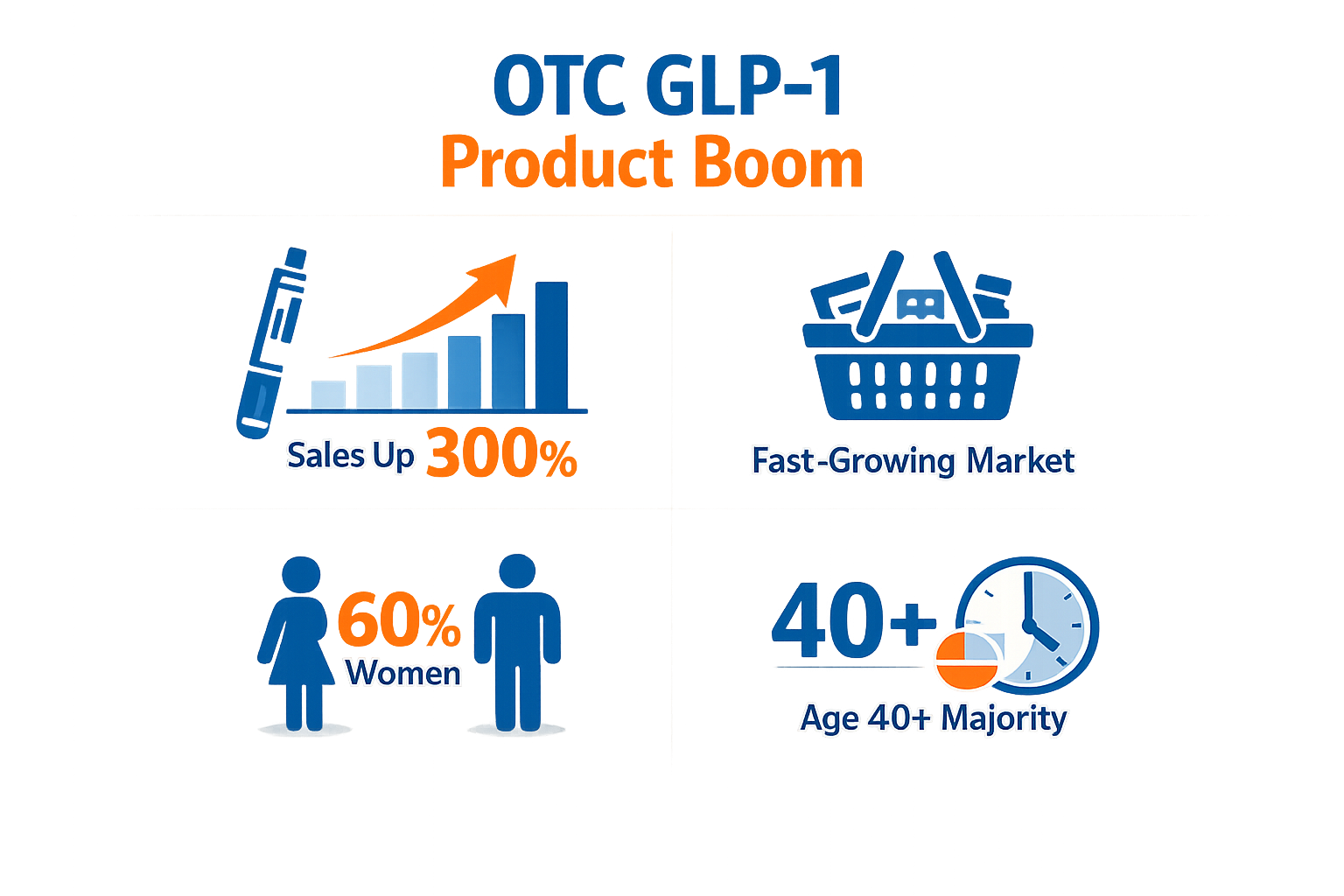
Over the past few years, a new category of products has appeared on supplement shelves and online marketplaces: gummies, powders, and capsules marketed as "over-the-counter GLP-1" or "natural GLP-1 support." These products have gained traction alongside the visibility of prescription GLP-1 receptor agonists — medications like semaglutide and tirzepatide that have become household names for their weight-loss and glucose-management effects. The marketing is often compelling: the promise of similar benefits without the prescription, the injections, or the cost.
Marketing Strategies Behind OTC GLP-1 Claims
The supplement industry has moved quickly to capitalize on public interest in GLP-1 medications. Advertising for these products frequently uses language that mirrors prescription drug benefits — phrases like "supports healthy GLP-1 levels," "natural weight management," or "metabolic support" — without making explicit medical claims that would trigger FDA regulation as drugs. Social media influencers, wellness blogs, and direct-to-consumer advertising have amplified these messages, often presenting the products as accessible alternatives for people who cannot afford or access prescription GLP-1 medications.
Some marketing materials display before-and-after photos, testimonials, or references to "clinical ingredients," creating an impression of efficacy that may not be supported by rigorous evidence. The visual and verbal cues are designed to evoke the outcomes associated with prescription GLP-1 drugs, even when the active ingredients and mechanisms are fundamentally different. For context on how other supplements are marketed with similar claims, see Vitamins Diabetics Should Avoid: Risks and Safe Alternatives.
Consumer Misconceptions and Expectations
Many people encountering these products assume they contain the same active pharmaceutical ingredient found in prescription GLP-1 medications — or at least a closely related compound that works in a similar way. This is not the case. Prescription GLP-1 receptor agonists are synthetic peptides that directly bind to and activate GLP-1 receptors in the body, triggering a cascade of metabolic effects including insulin secretion, delayed gastric emptying, and appetite suppression. Over-the-counter products do not contain these peptides.
Instead, OTC "GLP-1 gummies" typically contain a blend of vitamins, minerals, plant extracts, and amino acids — ingredients that manufacturers claim may support the body's natural production of GLP-1 or improve metabolic function more generally. The gap between consumer expectation (a product that works like semaglutide) and reality (a supplement with indirect, modest, or unproven effects) is significant.
Another common misconception is that "natural" or "plant-based" automatically means safe and effective. While some ingredients in these products have been studied for metabolic effects, the evidence is often preliminary, conducted in animal models, or limited to small human trials. The dosages, formulations, and combinations used in commercial gummies may differ from those in published research, and the products themselves are rarely tested in clinical trials as complete formulations.
The Regulatory Landscape
Dietary supplements in the United States are regulated under the Dietary Supplement Health and Education Act (DSHEA), which places the burden of safety on manufacturers but does not require pre-market proof of efficacy. Companies can market a supplement as long as they do not make explicit disease claims (e.g., "treats diabetes" or "lowers A1C") and include a disclaimer that the product is not intended to diagnose, treat, cure, or prevent any disease. This regulatory framework allows a wide range of products to reach consumers without the rigorous vetting required for prescription medications.
For people navigating diabetes management, this distinction matters. A prescription GLP-1 medication has been tested in large, controlled clinical trials, reviewed by the FDA, and approved for specific indications. An over-the-counter "GLP-1 gummy" has not. The absence of regulatory oversight does not mean the product is unsafe, but it does mean that claims of effectiveness should be approached with caution and verified independently.
What Over-the-Counter GLP-1 Gummies Actually Contain
Despite the name, over-the-counter "GLP-1 gummies" do not contain glucagon-like peptide-1 (GLP-1) or any pharmaceutical GLP-1 receptor agonist. GLP-1 is a gut hormone that regulates insulin secretion and appetite, and prescription GLP-1 receptor agonists like semaglutide (Ozempic, Wegovy) and tirzepatide (Mounjaro, Zepbound) are injectable medications approved by the FDA for type 2 diabetes and weight management. These prescription drugs work by mimicking the action of natural GLP-1 in the body — they are not available over the counter, and they cannot legally be sold in gummy form without FDA approval.
What you find labeled as "GLP-1 gummies" on retail shelves or online are dietary supplements that typically contain plant extracts, vitamins, or amino acids marketed to support weight loss or blood sugar management. Common ingredients include berberine, chromium, green tea extract, apple cider vinegar powder, or fiber blends. These supplements do not require FDA approval before sale, and manufacturers are not permitted to claim they treat, cure, or prevent any disease. The "GLP-1" branding is a marketing strategy that capitalizes on the popularity of prescription GLP-1 drugs, but the gummies themselves have no pharmaceutical GLP-1 activity.
How OTC Gummies Differ from Prescription GLP-1 Drugs
Prescription GLP-1 receptor agonists are biologic drugs — synthetic proteins that bind to GLP-1 receptors in the pancreas, brain, and gut to lower blood sugar, slow gastric emptying, and reduce appetite. They undergo rigorous clinical trials to demonstrate safety and efficacy, and they are dosed precisely by injection (or in one case, oral tablet). The SURPASS trials, for example, demonstrated significant weight loss with tirzepatide, a dual GLP-1/GIP receptor agonist, leading to its approval for obesity treatment.
OTC gummies, by contrast, contain no GLP-1 receptor agonists and are not tested in the same controlled clinical trials. Their ingredients may have modest effects on metabolism or satiety in some studies, but these effects are not equivalent to the mechanism of action of prescription GLP-1 drugs. A gummy containing berberine, for instance, may influence blood glucose through different pathways — such as improving insulin sensitivity — but it does not activate GLP-1 receptors. The dose, bioavailability, and quality of ingredients in supplements also vary widely, and there is no regulatory requirement for manufacturers to prove efficacy before marketing.
Potential Benefits and Limitations
Some ingredients in OTC gummies may offer modest metabolic support. Berberine, for example, has been studied for its effects on blood glucose and insulin sensitivity, though the evidence is not as robust as for metformin or GLP-1 drugs. Chromium and fiber may help with blood sugar regulation in some individuals. However, these effects are typically small, variable, and not a substitute for prescription medication when medication is indicated.
The limitations are significant. Because supplements are not FDA-approved drugs, their potency and purity are not guaranteed. Independent testing by organizations like ConsumerLab or NSF International sometimes reveals that products do not contain the labeled dose, or that they contain contaminants. Additionally, the marketing of these gummies can be misleading — implying they work "like" prescription GLP-1 drugs when they do not share the same mechanism or evidence base. For someone newly navigating diabetes or weight management, this can create confusion about what tools are actually available and effective.
If you are exploring alternatives to prescription medications, it is worth asking your care team about the specific ingredients in any supplement you are considering. Some may be safe adjuncts to your current plan; others may be unnecessary or even risky depending on your health status and other medications. For more context on evaluating supplement claims, see Vitamins Diabetics Should Avoid: Risks and Safe Alternatives. You may also want to learn about Victoza Generic and Cost in 2026: What to Expect if you're considering prescription GLP-1 options.
Conclusion and Recommendations
The phrase "over-the-counter GLP-1" appears frequently in online supplement marketing, but it refers to products that do not contain the GLP-1 hormone itself. Prescription GLP-1 receptor agonists — semaglutide, liraglutide, dulaglutide, and others — are injectable or oral medications that require a prescription, medical supervision, and careful titration. The gummies, capsules, and powders sold without a prescription typically contain ingredients intended to support the body's own GLP-1 production or mimic some of its metabolic effects, but they are not pharmaceutical GLP-1 and do not carry FDA approval for diabetes or weight management.
For anyone newly diagnosed or exploring medication options, the distinction matters. Prescription GLP-1 therapies have undergone rigorous clinical trials demonstrating their efficacy in lowering A1C and supporting weight loss in people with type 2 diabetes. Over-the-counter supplements lack that level of evidence. If you see a product marketed as "GLP-1 support" or "natural GLP-1," read the ingredient list carefully and recognize that it is not a substitute for a prescribed medication. Never reduce, stop, or replace insulin or any other prescribed diabetes medication with a supplement without explicit guidance from your care team.
What to Ask Your Care Team
If you are considering an over-the-counter product labeled as GLP-1 support, bring the ingredient list to your next appointment. Ask whether any of the ingredients — berberine, chromium, fiber blends, or others — might interact with your current medications or affect your blood-glucose patterns. Your care team can help you evaluate whether the supplement is safe in your specific situation and whether it is likely to offer any meaningful benefit given your current treatment plan.
If your interest in over-the-counter GLP-1 products stems from difficulty affording or accessing prescription GLP-1 therapies, tell your provider. There may be patient-assistance programs, alternative medications, or coverage pathways you have not yet explored. Supplements are not a workaround for prescription access — they are a different category of product with different mechanisms and different evidence.
Evaluating Supplement Claims
When you encounter marketing for "GLP-1 gummies" or similar products, apply the same scrutiny you would to any supplement claim. Look for third-party testing (USP, NSF, or ConsumerLab verification), check for a clear ingredient list with dosages, and search for peer-reviewed research on the specific formulation — not just on individual ingredients in isolation. Be cautious of before-and-after testimonials, promises of rapid weight loss, or language that positions the product as equivalent to prescription medication.
Remember that the supplement industry is not subject to the same pre-market approval process as pharmaceuticals. A product can be sold legally even if it has not been tested in clinical trials for efficacy or safety in people with diabetes. That does not make every supplement dangerous, but it does mean the burden of evaluation falls largely on you and your care team.
Where to Go for Reliable Information
For evidence-based guidance on GLP-1 therapies, the ADA Standards of Care provide current recommendations on the use of GLP-1 receptor agonists in type 2 diabetes management. For questions about specific supplements, the National Institutes of Health Office of Dietary Supplements maintains fact sheets on common ingredients. If you are navigating medication decisions or trying to decode conflicting information, your endocrinologist, certified diabetes care and education specialist, or pharmacist can help you separate marketing from mechanism.
Over-the-counter products marketed as GLP-1 alternatives may play a role in some people's broader wellness routines, but they are not a replacement for medical treatment, and they are not "GLP-1" in the pharmaceutical sense. Clarifying that distinction is the first step toward making informed decisions about your diabetes care. For more context on evaluating supplement claims in diabetes, see Does Apple Cider Vinegar Lower Blood Sugar.

Maren Alcott is the lead presenter at DiabetesCompass. She is an AI-presented digital character. Every article Maren presents is researched and fact-checked by the DiabetesCompass editorial team against the ADA Standards of Care, peer-reviewed journals, and named clinical sources. Maren does not give medical advice — for questions about your specific situation, talk to your care team.